
Why Construction Estimating Workflow Software Should Include Built-In Task Management

Dhyna PhilsHead of Marketing
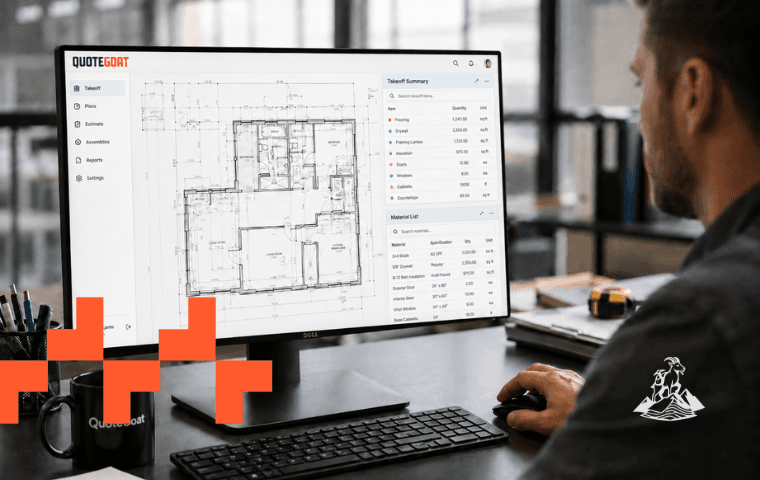
Most estimating teams do not lose control of a bid because they cannot calculate quantities. They lose control because the work around the estimate gets scattered. A subcontractor quote request lives in an email. A scope clarification is buried in a chat thread. A review note sits in a spreadsheet. A project manager remembers that someone was supposed to check an alternative, but no one can find the final answer. A senior estimator knows which scope item looks risky, but the task to resolve it is not connected to the estimate line where that risk actually lives.
That is the real workflow problem. Construction estimating software has traditionally focused on helping teams build the numbers faster. But speed alone does not protect a bid. Estimating teams also need a way to manage the work required to get the number right.
That is where construction estimating workflow software becomes important.
Construction estimating workflow software helps estimators and preconstruction teams organize, assign, and complete bid-related work within the estimating process, including quote follow-up, scope review, pricing tasks, checklist items, and final bid coordination.
The difference may sound small. It is not.
When task management lives outside the estimate, teams spend too much time searching for context and too little time resolving risk. When task management lives inside the estimate, the work, the scope, the files, the people, and the decision trail stay connected.
For estimators, preconstruction managers, project managers, specialty contractors, and construction business owners, the point is simple: the estimate is not just a spreadsheet of costs. It is the operating center for bid decisions.
The task work should live there too, right alongside pinpoint accuracy.
Why Estimating Teams Still Pay a Context-Switching Tax
Every estimating team has a version of the same problem.
The bid is moving fast. The deadline is fixed. The drawing set is changing. Subcontractors are responding at different times. Internal reviewers are asking questions. Leadership wants status. Operations may need input. Someone is trying to confirm exclusions. Someone else is checking whether a scope item appears in the drawings, the specs, or both.
None of that work is optional.
But too often, it happens across too many systems.
Estimators may use one platform for takeoff, another for estimating, another for file storage, another for task tracking, another for chat, another for email, and another for bid calendar management. Each tool may be useful on its own. Together, they create a context-switching tax.
That tax shows up in several ways.
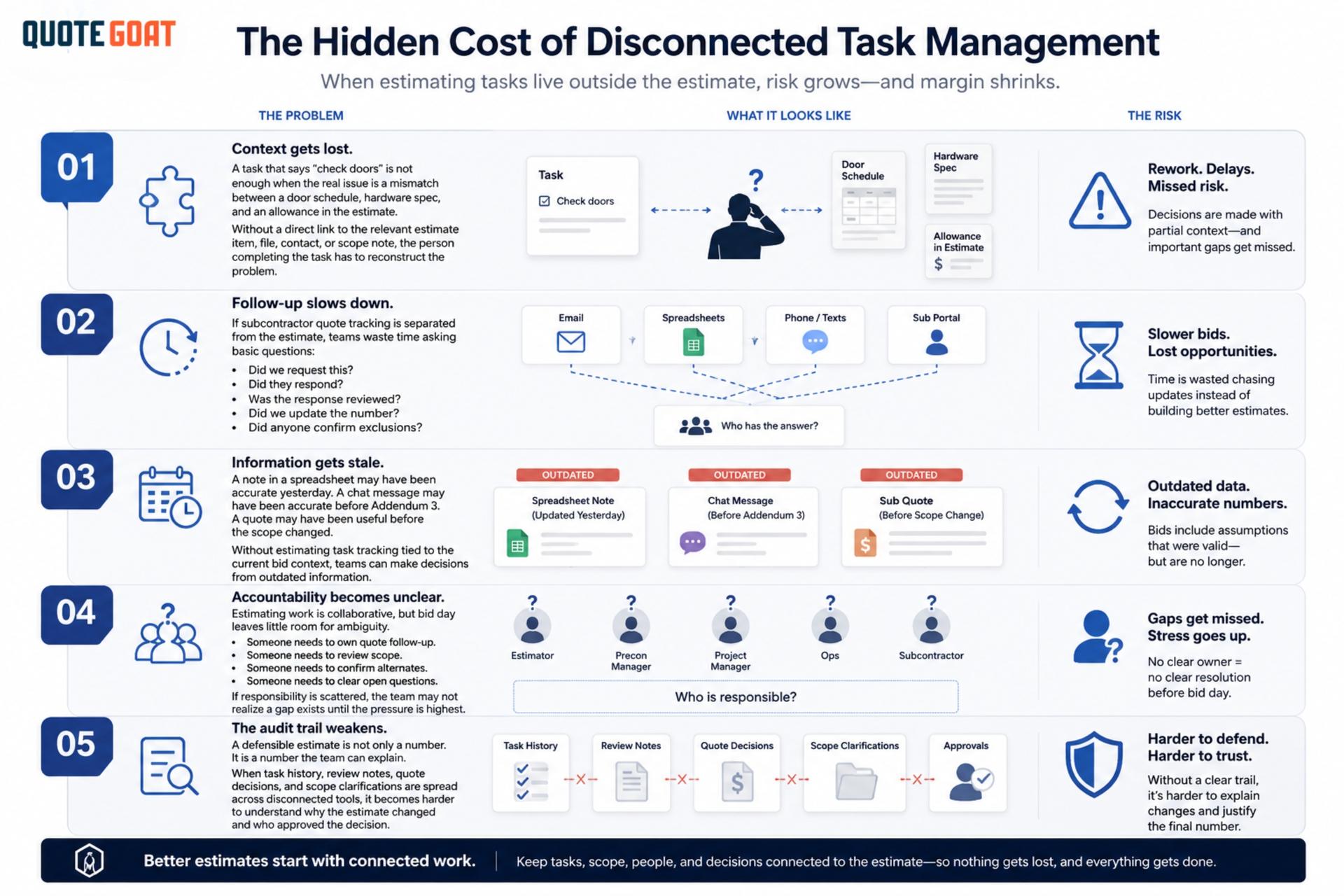
First, context gets lost. A task that says “check doors” is not enough when the real issue is a mismatch between a door schedule, hardware spec, and an allowance in the estimate. Without a direct link to the relevant estimate item, file, contact, or scope note, the person completing the task has to reconstruct the problem.
Second, follow-up slows down. If subcontractor quote tracking is separated from the estimate, teams waste time asking basic questions: Did we request this? Did they respond? Was the response reviewed? Did we update the number? Did anyone confirm exclusions?
Third, information gets stale. A note in a spreadsheet may have been accurate yesterday. A chat message may have been accurate before Addendum 3. A quote may have been useful before the scope changed. Without estimating task tracking tied to the current bid context, teams can make decisions from outdated information.
Fourth, accountability becomes unclear. Estimating work is collaborative, but bid day leaves little room for ambiguity. Someone needs to own the quote follow-up. Someone needs to review the scope. Someone needs to confirm alternates. Someone needs to clear open questions before submission. If responsibility is scattered, the team may not realize a gap exists until the pressure is highest.
Finally, the audit trail weakens. A defensible estimate is not only a number. It is a number the team can explain. When task history, review notes, quote decisions, and scope clarifications are spread across disconnected tools, it becomes harder to understand why the estimate changed and who approved the decision.
This is important because estimating is not only about speed. It is about confidence under pressure.
Why Generic Task Management Fails in Preconstruction
Generic task management software can be useful. It can help teams assign work, set deadlines, add comments, and track completion.
But preconstruction is not generic work.
A construction estimating software task is rarely just a task. It is usually attached to a specific scope item, a bid package, a pay item, a CSI division, a plan sheet, a subcontractor, a vendor, a quote, an addendum, an alternate, or a risk item.
A generic PM task might say, “Follow up with electrical sub.” That is better than relying on memory. But it still leaves important questions outside the task itself.
Which project? Which bid package? Which drawings? Which quote request? Which scope section? Which estimate line? Was the sub being asked about base scope, an alternate, an exclusion, or a substitution? Did their response change the estimate?
If the estimator has to leave the estimate to answer those questions, the workflow is already fractured.
This is why task management for construction estimating needs to be different from general task management. Estimators do not just need reminders. They need estimate-aware reminders.
Generic tools often fail preconstruction teams for five reasons.
They are not linked to the estimate structure. They do not understand CBS lines, pay items, alternates, cost codes, or bid packages.
They are not built around estimating phases. Pre-bid review, quantity takeoff, scope review, quote follow-up, bid leveling, internal review, and final submission each have different requirements.
They create extra administration. Estimators already carry enough detail in their heads. A task system that requires duplicate entry becomes one more thing to maintain.
They do not support strong coordination with subcontractors and vendors. Preconstruction task management often depends on outside responses from people who should not need to log into another system just to answer a quote question.
They do not create an estimating-native audit trail. A completed task is useful, but it is more useful when it is connected to the estimated item it affected.
This does not mean generic project management tools are bad. It means they were not designed around bid risk.
Construction estimating collaboration software needs to preserve the relationship between the work being done and the estimate being built.
What Construction Estimating Workflow Software Should Actually Include
Good construction estimating workflow software should help teams manage the whole estimating process, not only the math.
That includes takeoff, pricing, scope review, quote coordination, internal review, and final bid preparation. It also includes the task layer that keeps that work moving.
At a minimum, an estimating platform with task management should include the following capabilities.
Tasks should link directly to the estimate data. A task should be able to attach to a CBS line, pay item, file, contact, scope note, or other estimate entity. That way, the person doing the work does not have to search for the reason the task exists.
The platform should provide cross-project visibility. Estimating teams rarely work on one bid at a time. Leaders need to see overdue tasks, upcoming deadlines, open quote items, and unresolved review issues across active projects.
It should support templates and phases. Construction estimating software with templates helps teams standardize repeatable workflows, especially for recurring project types, trade packages, and internal review processes.
It should support internal and external assignments. Some tasks belong to estimators. Some belong to preconstruction managers. Some require input from project managers. Some depend on subcontractors or vendors.
It should include private tasks. Not every note belongs to every stakeholder. Teams need space to manage internal review items, pricing concerns, and scope questions before sharing them externally.
It should provide alerts, digests, and activity history. A bid workflow software system should reduce manual chasing, not add to it.
It should support an audit trail. AI estimating software with audit-trail functionality helps teams understand what changed, when it changed, and who made the change.
It should strengthen the estimate review. Estimating software with scope review should make it easier to identify unresolved items before bid day, not after the work has already moved to operations.
This is the practical standard for modern preconstruction workflow software. It should centralize the work, preserve context, and help teams move from an open question to a resolved decision without losing the thread.
What Built-In Task Management Looks Like in QuoteGoat
QuoteGoat approaches task management from inside the estimating workflow.
Instead of asking estimators to manage bid-critical work in a separate system, QuoteGoat keeps tasks connected to the estimate itself. The goal is not to create another place to check. The goal is to reduce the number of places teams need to check.
In QuoteGoat, tasks can be tied to the estimating context that created them: CBS lines, pay items, contacts, and files. That means a task is not floating separately from the bid. It is attached to the work it affects.
For an estimator, that saves time. For a preconstruction manager, it improves visibility. For a project manager involved in bid coordination, it clarifies what still needs attention. For a business owner, it reduces the risk that important work depends on memory or informal follow-up.
QuoteGoat also supports cross-project task visibility. That is important because estimating teams are often balancing several bids at once. A single-project task list may help one estimator, but leadership needs a broader view. They need to know where the bottlenecks are, which bids are at risk, and what needs attention before the deadline closes in on them.
Templates and phases make the workflow repeatable. This is crucial for teams trying to standardize estimating operations. Without templates, every estimator may manage the bid differently. One person may be disciplined about following up on quotes. Another may rely on memory. One may use checklists. Another may use email folders. That variation creates risk.
Estimating checklist software works best when the checklist is integrated into the estimating workflow. QuoteGoat’s template and phase structure help turn best practices into standard operating procedure.
Subcontractor and vendor notifications also matter. In preconstruction, external coordination is often where bids slow down. If a subcontractor needs to respond to a task, the process should be simple. The easier it is for outside parties to respond, the easier it is for the estimating team to keep the bid moving.
The larger point is that QuoteGoat treats task management as part of estimate quality. It fits QuoteGoat’s broader role as a Scope Intelligence platform built to help construction teams produce complete, defensible, risk-aware estimates by identifying omissions, contradictions, and scope gaps before they become expensive mistakes.
Task management is not separate from that mission. It is one way teams act on the risks they find.

How Estimate-Linked Tasks Reduce Risk Before Bid Day
Bid risk does not usually appear all at once. It builds quietly. A quote is requested but not received. A scope note is added but not reviewed. An addendum changes the drawings, but not everyone updates their assumptions. A contradiction appears between sheets. A vendor clarification comes in late. An alternate needs pricing, but the responsibility is unclear.
None of those items may look catastrophic in isolation. Together, they can weaken the estimate. Estimate-linked task management helps reduce that risk by making unresolved work visible.
When a task is tied directly to the estimate, the team can see not only that work remains, but where that work affects the bid. That is the key difference between a generic task list and risk-aware estimating software.
A task list says, “Follow up.” An estimate-linked task says, “Follow up on this scope item because it affects this line, this quote, this file, and this bid decision.” That level of context protects the estimate in several ways.
- It reduces missed follow-ups. Quote collection is one of the most time-sensitive parts of bid preparation. If follow-up tasks are connected to the relevant contacts and scope items, teams are less likely to lose track of who owes what.
- It reduces stale pricing. Pricing changes quickly. If a quote has not been updated after a scope change, the estimate may look complete while carrying an outdated assumption.
- It improves review discipline. Scope review is easier when open items are organized and assigned. Teams can methodically address unresolved risks instead of relying on a last-minute scramble.
- It strengthens accountability. Every task needs an owner. Every owner needs context. Every unresolved item needs visibility.
- It creates a cleaner handoff. When operations receive a bid, they should not inherit a mystery. They should be able to understand what was reviewed, what was assumed, what was clarified, and what still needs attention.
This is how built-in task management helps create defensible construction estimates. It does not replace estimator judgment. It gives that judgment a stronger workflow.
How Cross-Project Visibility Helps Preconstruction Leaders
Estimators often feel the pain of disconnected task tracking first. But preconstruction leaders feel the consequences.
A manager responsible for several active bids cannot rely solely on informal updates. They need to know which projects are on track, which are waiting on outside input, which have unresolved scope issues, and which are heading toward a bid-day bottleneck.
That is where construction bid coordination software needs to go beyond individual task lists. Cross-project visibility helps leaders answer practical questions:
Which bid has the most overdue tasks?
Which estimator is overloaded?
Which subcontractor responses are still missing?
Which projects have unresolved scope review items?
Which deadlines are at risk?
Which bids are ready for final review?
Without that visibility, managers often spend their time chasing status instead of improving outcomes. They ask for updates in meetings. They check spreadsheets. They search the email. They interrupt estimators who are already trying to finish the work.
A stronger workflow gives leaders a live view of the estimating operation. It helps them prioritize support where it matters most. It also helps newer team members follow a consistent process rather than relying on tribal knowledge.
This is especially important for construction estimating software for general contractors, where multiple bid packages, subcontractor responses, alternates, and internal reviews may be progressing simultaneously. But it also is important for specialty contractors managing quotes, scope follow-up, and trade-specific risk across several opportunities.
The larger the team, the more important standardization becomes. But even small teams benefit from clarity. A two-person estimating department can still lose margin if a critical task falls through the cracks.
Why Task Management Belongs Inside a Scope Intelligence Platform
QuoteGoat is not trying to replace field project management software. That is not the point.
The point is that preconstruction has its own layer of coordination. Scope, pricing, drawings, specs, quotes, review notes, and bid tasks all interact with one another before the project is awarded. When those pieces are disconnected, the estimate becomes harder to trust.
That is why task management belongs inside a Scope Intelligence platform.
Scope Intelligence is about seeing what might otherwise be missed: omissions, contradictions, missing scope, scope boundary issues, and inconsistencies across the project documents. QuoteGoat is built to help teams catch those issues before they become costly mistakes.
But identifying risk is only part of the job. Someone has to resolve it.
If AI plan review software flags a possible conflict, the team needs a task to investigate it. If scope gap detection software surfaces a missing item, someone needs to assign ownership. If omission detection in estimating identifies a likely miss, that issue needs to be reviewed, priced, excluded, clarified, or escalated. If cross-sheet contradiction detection reveals a mismatch between drawings, the team needs to track the decision.
That is where built-in task management becomes operationally important. AI construction estimating software can help teams see more. But estimating teams still need a clear way to act on what they see.
This is the bridge between intelligence and execution. A Scope Intelligence platform should not only tell the team, “Here is a risk.” It should help the team ask, “Who owns it, what does it affect, what is the next step, and has it been resolved?” That is how preconstruction teams move from insight to control.
It helps estimators work with context. It helps preconstruction managers create consistency. It helps project managers understand what still needs attention. It helps business owners reduce avoidable estimating risk.
Most importantly, it helps teams produce estimates they can stand behind.
QuoteGoat’s approach is built around that standard: keep the work connected to the estimate, keep risk visible, and give teams the clarity they need before the bid goes out. See how QuoteGoat helps estimating teams manage bid-critical work without leaving the estimate.