
AI Takeoff And Estimating Explained: How Contractors Get Faster Bids Without Losing Control

Dhyna PhilsHead of Marketing

Estimating pressure usually shows up the same way. Plans land late, the due date is too close, and the first question is not even about price. It is about confidence. Did we capture the scope, or did we just produce a number that looks clean until it gets tested in the field? That is the real gap modern teams are trying to close.
Speed helps, but speed without visibility turns into rework, change orders, and uncomfortable handoffs to project management. That is why AI takeoff is getting so much attention right now. Contractors do not want another shiny tool. They want fewer missed items, fewer contradictions hiding in documents, and a workflow that gives them a real first pass instead of a guess dressed up as progress.
The goal of this guide is simple: explain what AI takeoff actually means in estimating terms, where it helps, where it still needs human review, and how it fits into the broader workflow that keeps bids defensible.
What AI Takeoff Actually Means In Real Estimating Terms
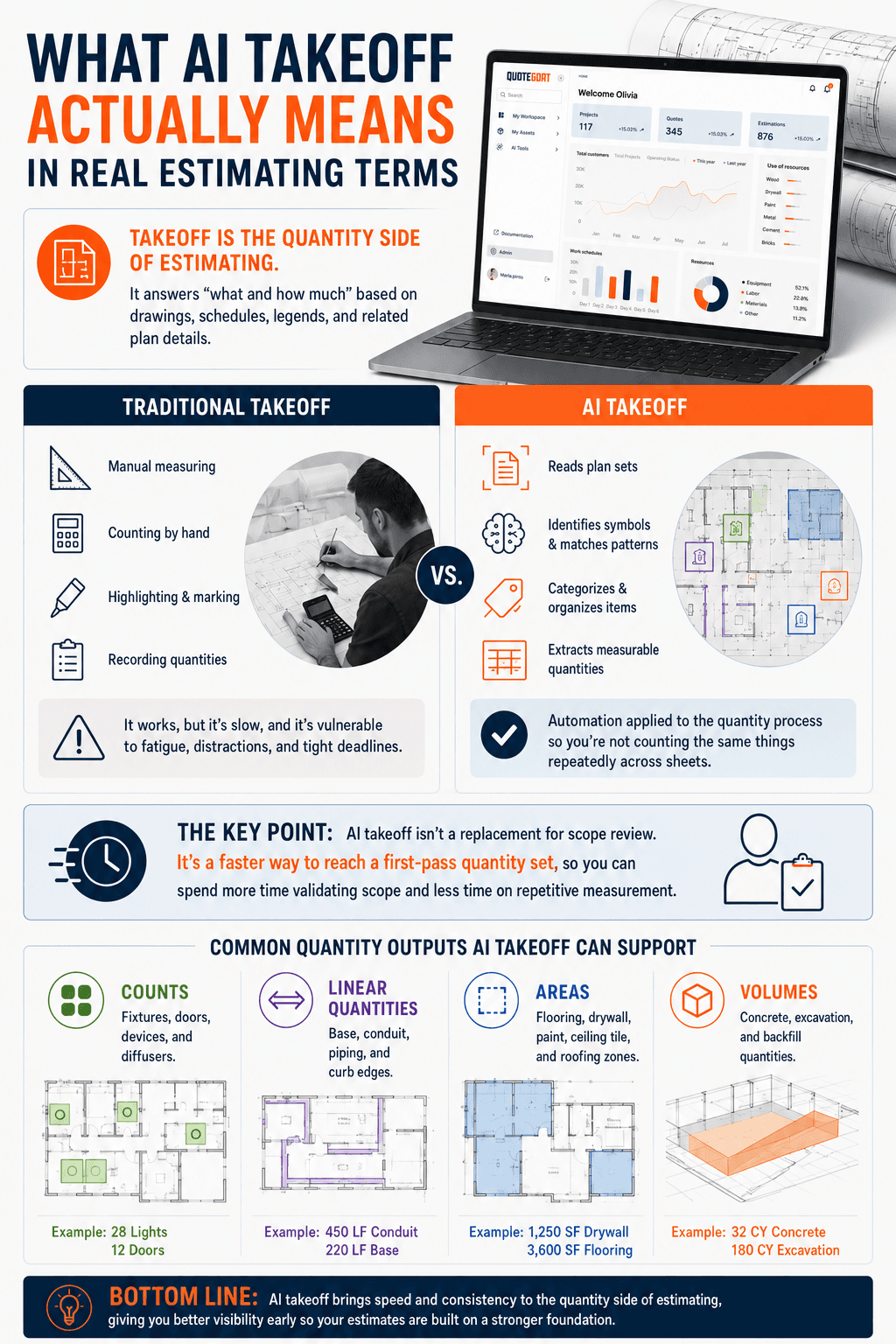
Takeoff is the quantity side of estimating. It answers "what and how much" based on drawings, schedules, legends, and related plan details. Traditional takeoff means that an estimator manually measures, counts, highlights, and records quantities. It works, but it is slow, and it is vulnerable to fatigue, distractions, and tight deadlines.
AI takeoff is simply automation applied to that quantity process. Instead of starting from a blank slate, the system reads plan sets and extracts measurable items into usable quantities. It can identify symbols, match patterns, and associate items with categories so you are not counting the same things repeatedly across sheets.
The key point is that AI takeoff is not a replacement for scope review. It is a faster way to reach a first-pass quantity set, so the estimator can spend more time validating scope and less time on repetitive measurement.
Here are common quantity outputs that automated systems can support:
- Counts, such as fixtures, doors, devices, and diffusers.
- Linear quantities, such as base, conduit, piping, and curb edges.
- Areas such as flooring, drywall, paint, ceiling tile, and roofing zones.
- Volumes, such as concrete, excavation, and backfill quantities.
Takeoff Versus Estimating: The Difference That Keeps Bids From Falling Apart
Takeoff and estimating are lumped together in everyday conversation, which causes real workflow confusion. Takeoff is about quantities. Estimating is about turning those quantities into a buildable, priced plan that accounts for labor, material, equipment, overhead, and risk.
A clean quantity set does not automatically produce a clean estimate. The estimate still depends on assumptions, assemblies, crew productivity, spec interpretation, and the commercial decisions that shape what you include, exclude, or qualify.
You can see the practical version of this comparison, but the short version looks like this:
- Takeoff answers what is present in the documents.
- Estimating answers what it will take to build it with your team, pricing, and risk tolerance.
- Scope review answers what is missing, unclear, contradictory, or buried in notes.
- Bid strategy answers how you will present the number and protect the business.
Teams run into trouble when they treat takeoff as the whole estimate. That is when you end up with accurate measurements paired with an incomplete scope, weak assumptions, or missing accessories that only show up after award.
What Automated Takeoff Software Does Well And Where It Still Needs You
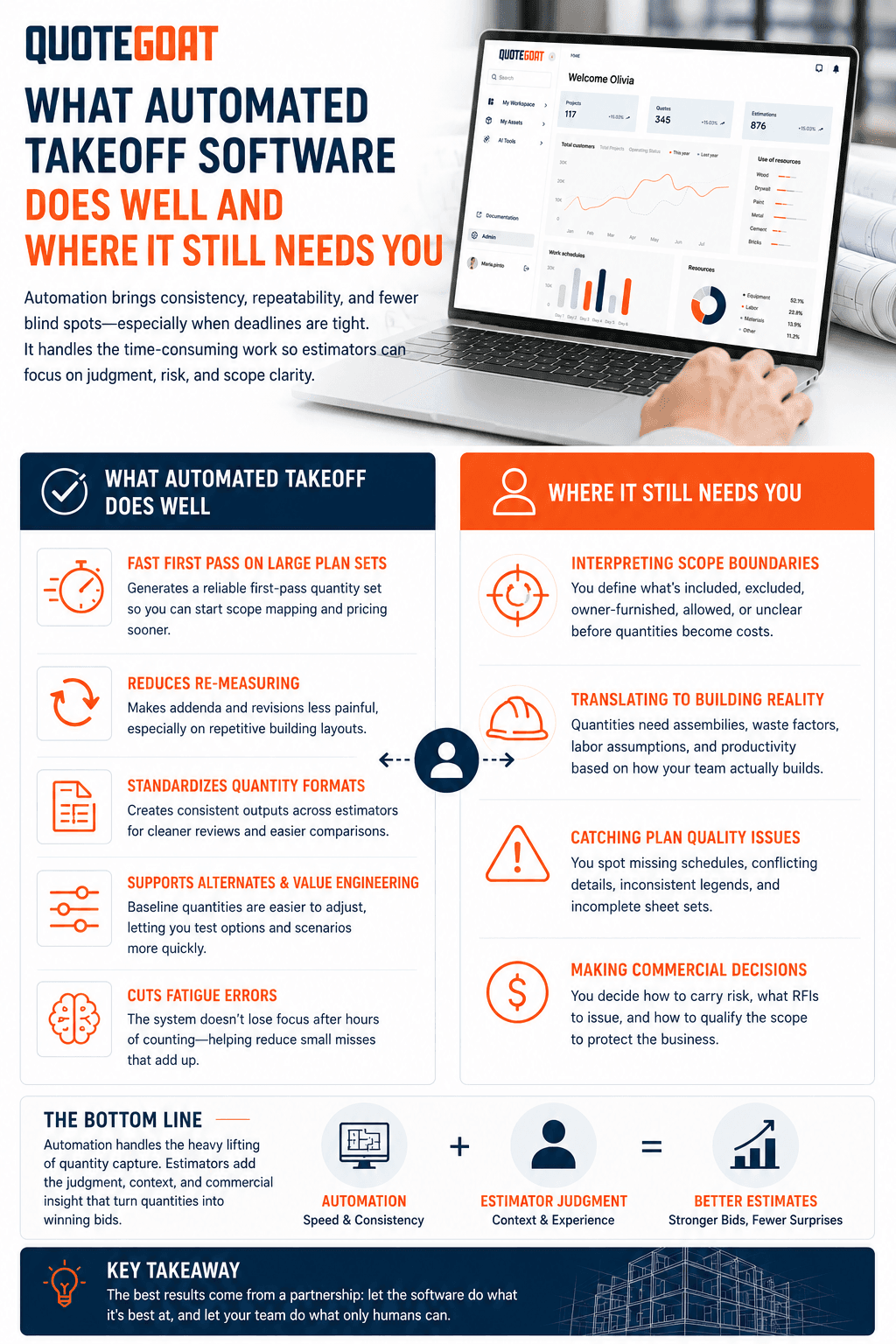
Automation has real strengths in estimating, and it is not just about cutting time. The greater value is consistency, repeatability, and reduced blind spots that arise under deadline pressure. In practice, AI takeoff often helps teams move faster on the parts that drain time and attention, so humans can focus on judgment and scope clarity.
Here is what automated takeoff tends to do well for real-world estimating teams:
- Producing a fast first pass on large plan sets so you can start scope mapping sooner.
- Reducing re-measuring during addenda and revisions, especially on repetitive building layouts.
- Helping standardize quantity formats across estimators to make reviews cleaner.
- Supporting alternates and value engineering more quickly, since baseline quantities are easier to adjust.
- Cutting fatigue errors, since the system does not lose focus after four hours of counting.
That said, plan sets are messy in the real world. Specs conflict with drawings. Legends change between sheets. Notes contain scope requirements that never show up in the graphics. This is exactly where estimators still earn their value.
Estimator oversight still matters most in areas like these:
- Interpreting scope boundaries, such as owner-furnished items, exclusions, allowances, and clarifications.
- Translating quantities into assemblies, waste factors, labor assumptions, and production reality.
- Catching plan quality issues, such as missing schedules, conflicting details, and incomplete sheet sets.
- Making commercial decisions, such as taking on risk, issuing RFIs, or tightening qualifications.
How AI Takeoff Fits Inside A Modern Estimating Workflow
Most estimating teams do not need a full workflow rewrite. They need fewer bottlenecks, better visibility, and less rework when drawings change. That is why the best adoption plans start with the workflow you already have, then add automation to remove friction without losing control.
A realistic estimating workflow usually looks like this:
- Intake and document control, including plan set versions and addenda tracking.
- Trade breakdown and scope structure, so everyone is pricing the same categories.
- Takeoff and quantity capture.
- Assemblies, labor, and pricing logic tied to those quantities.
- Review, risk checks, and clarifications.
- Proposal build and bid submission.
AI takeoff fits into this workflow in a very specific way. It accelerates the quantity phase and makes revisions less painful, while also helping surface scope issues earlier. That only works if the process keeps a human review step built into the loop.
A simple rollout approach that does not break your process looks like this:
- Start with one project type you bid on frequently, so improvements do not go to waste.
- Run AI takeoff in parallel with your current baseline for a few bids.
- Validate the biggest cost drivers first, not random items.
- Document what changed and feed that back into your templates.
Accuracy: What Good Enough Actually Means In Takeoff And Estimating
Accuracy is discussed as if it is a single number, but estimating accuracy is layered. There is quantity accuracy, and there is estimated accuracy. You can nail one and still miss the other if the workflow does not force a real scope review and pricing reality check.
Quantity accuracy asks a basic question: Did we count and measure correctly? That is where takeoff systems tend to perform well, especially on repeatable symbols and clean plan sets.
Estimate accuracy is broader. It depends on how you price, what you assume, and how you account for execution conditions. Market pricing shifts. Crew productivity shifts. Site access and phasing change production. Specs introduce hidden scope. Those things do not disappear because quantities are faster.
A practical way to think about accuracy is confidence scoring. Instead of pretending every output is perfect, you treat the estimate like a controlled decision process. The estimator checks high-impact scopes first, validates assumptions, and uses the tool to narrow down where a miss can hide.
High-impact scope areas worth double-checking on almost every bid include:
- Concrete and earthwork quantities, since small percentage swings can hit margins hard.
- Openings and hardware sets, since schedules and specs often diverge.
- Finish levels and spec requirements, since drawings do not always tell the full story.
- MEP fixtures and device counts, since legends and schedules can shift across sheets.
- Roof edges, penetrations, and flashing conditions, since details drive labor.
What Changes And What Does Not When You Move From Manual To AI-Assisted
Many contractors hesitate because they expect a tool to force them into an unfamiliar process. That fear is valid, especially if you have seen software rollouts that make the team slower for months. The truth is that modern AI-assisted estimating changes the allocation of time more than it changes the fundamentals.
What changes in the first pass? Estimators can reach an initial quantity set faster, allowing them to start thinking earlier. It also makes addenda less brutal, since the process is not redo everything from scratch every time sheets are reissued.
What does not change is the need for plan literacy and judgment. Someone still has to interpret scope intent, catch contradictions, decide how to qualify risk, and build a proposal that protects the business. AI does not do that work. It supports that work.
As teams mature with AI-assisted workflows, the estimator role often shifts toward higher-value activities:
- Validating outputs and focusing spot checks on scope drivers, not random items.
- Improving assemblies and templates to keep estimates consistent across the team.
- Keeping pricing libraries and labor assumptions clean and up to date.
- Documenting assumptions to help project management get a better handoff.
Residential Versus Commercial: Where Takeoff Pain Shows Up Differently
Residential and commercial contractors both benefit from faster takeoff, but the stress points are not identical. Residential teams often feel pressure to move quickly and be repeatable. Commercial teams often feel pressure in document volume, addenda frequency, and spec density.
In residential estimating, repeatable floor plans and options packages make takeoff automation especially useful. If you are bidding similar models across multiple lots, the ability to generate and revise quantities quickly can reduce overtime and tighten consistency. The risk in residential is often in selections, upgrade paths, and finish details that live outside the obvious plan graphics.
In commercial estimating, the challenge is scale and complexity. Larger plan sets, more disciplines, more stakeholders, and more addenda can bury risk in conflicting notes and cross-discipline gaps. Faster takeoff helps, but the bigger win is earlier visibility into scope issues so you can address them before bid day.
Good first projects for testing AI-assisted takeoff usually have two traits: they are repeatable, and they are clean enough to validate quickly.
- A repeatable residential model with consistent symbol legends and clean sheets.
- A small TI buildout with straightforward schedules and limited alternates.
- A bid type you pursue often, so workflow improvements compound over time.
- A project with multiple revisions expected, where revision speed matters.
How To Adopt AI Takeoff Without Disrupting Your Current Process
The fastest way to fail with AI is to treat it like a magic shortcut. The fastest way to succeed is to treat it like a controlled implementation, where inputs and outputs get standardized and the review routine stays intact.
A rollout plan that works for real estimating teams usually follows a staged approach:
First, standardize your inputs. If your team cannot keep drawings organized, track addenda cleanly, and label versions consistently, automation will not save you. It will just produce faster confusion.
Second, standardize your outputs. Quantity naming conventions, trade breakdown structure, and assembly mapping need to look consistent across the team. That is what makes review easier, and it is what keeps estimating from becoming a personality-driven process.
Third, create a review routine that fits your deadlines. Review does not have to be slow, but it has to be intentional. Spot-check scope drivers, compare against historical benchmarks, and confirm that the tool output matches the plan's intent.
Fourth, keep a feedback loop with the field. Estimators improve accuracy when project teams report what got missed, what got over-carried, and what assumptions did not survive reality.
Signals that the process is working show up quickly:
- Addenda revisions stop turning into full rebuilds of the takeoff.
- Proposal inclusions and exclusions get clearer because scope visibility improves.
- Project managers report fewer surprise gaps during buyout and early construction.
- The team can bid more work without burning out or sacrificing review quality.
Common Misconceptions Contractors Bring Into AI Takeoff
There is a lot of noise in the market. Some tools are solid. Some are just marketing. Misconceptions usually come from experiences with older systems, or from demos that overpromise and under-explain the real workflow.
One misconception is that AI replaces estimators. In reality, strong workflows keep the estimator as the final decision-maker. The tool supports visibility and consistency, and the human decides what it means.
Another misconception is that AI is only for large GCs. Smaller contractors often see huge value because the time saved and scope risk reduction hit harder when the team is lean. A two-person estimating group cannot afford endless rework.
There is also a belief that faster bids are always riskier bids. Faster number production is risky if it cuts review time. Faster takeoff can be safer if it gives you more time to review the scope, check assumptions, and build qualifications that protect the margin.
Ready To Tighten Your Takeoff And Estimating Workflow?
If your estimating team is spending more time measuring than reviewing, you do not have a speed problem. You have a visibility problem. The goal is not to rush bids out the door. The goal is to produce a clear, reviewable estimate that holds up after award.
QuoteGoat is built around that outcome: faster quantities, clearer visibility into scope, and fewer surprises that show up late. If you want to see how it fits your workflow, start here: quotegoat.ai/estimatingSoftware.
If you are not sure where to begin, the most practical next step is to map your current estimating flow and identify the biggest friction points. The right automation strategy does not replace your process. It strengthens it.