
How Contractors Reduce Estimating Errors With AI

Dhyna PhilsHead of Marketing
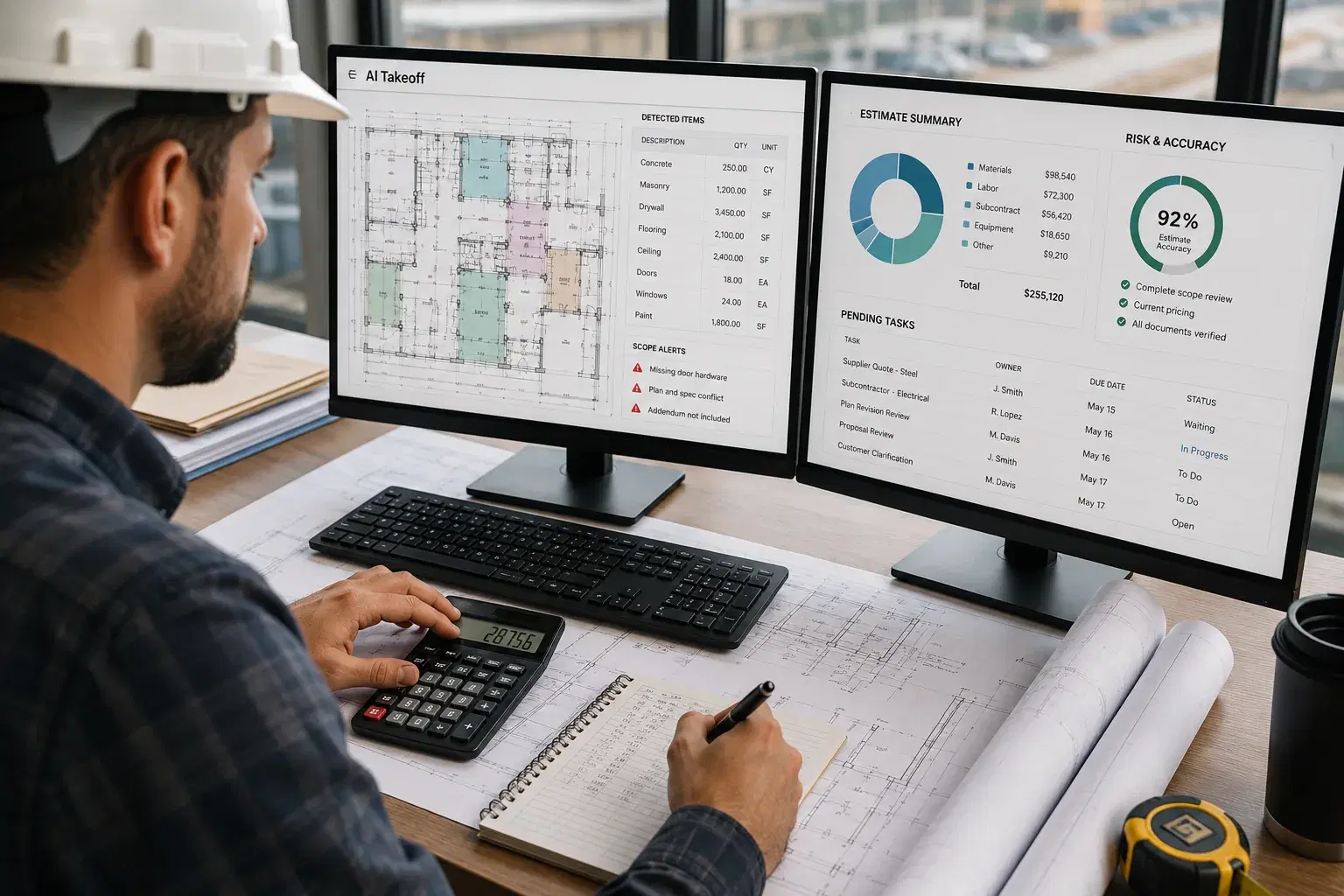
Estimating mistakes are expensive because they rarely stay on paper. A missed quantity, an outdated price, an unclear exclusion, a buried scope note, or a rushed assumption can lead a contractor straight into the job. Once the work starts, that mistake becomes a margin problem, a customer conversation, a change order fight, or a scheduling issue that nobody wants to own.
That is why more contractors are looking for ways to reduce estimating errors construction teams deal with before a bid ever goes out. AI does not replace contractor judgment, field experience, supplier relationships, or pricing discipline. It helps estimators organize information, review the scope more carefully, spot gaps earlier, and spend less time wrestling with repetitive manual work, creating room for better decisions.
Estimating Errors Usually Start Before The Final Number
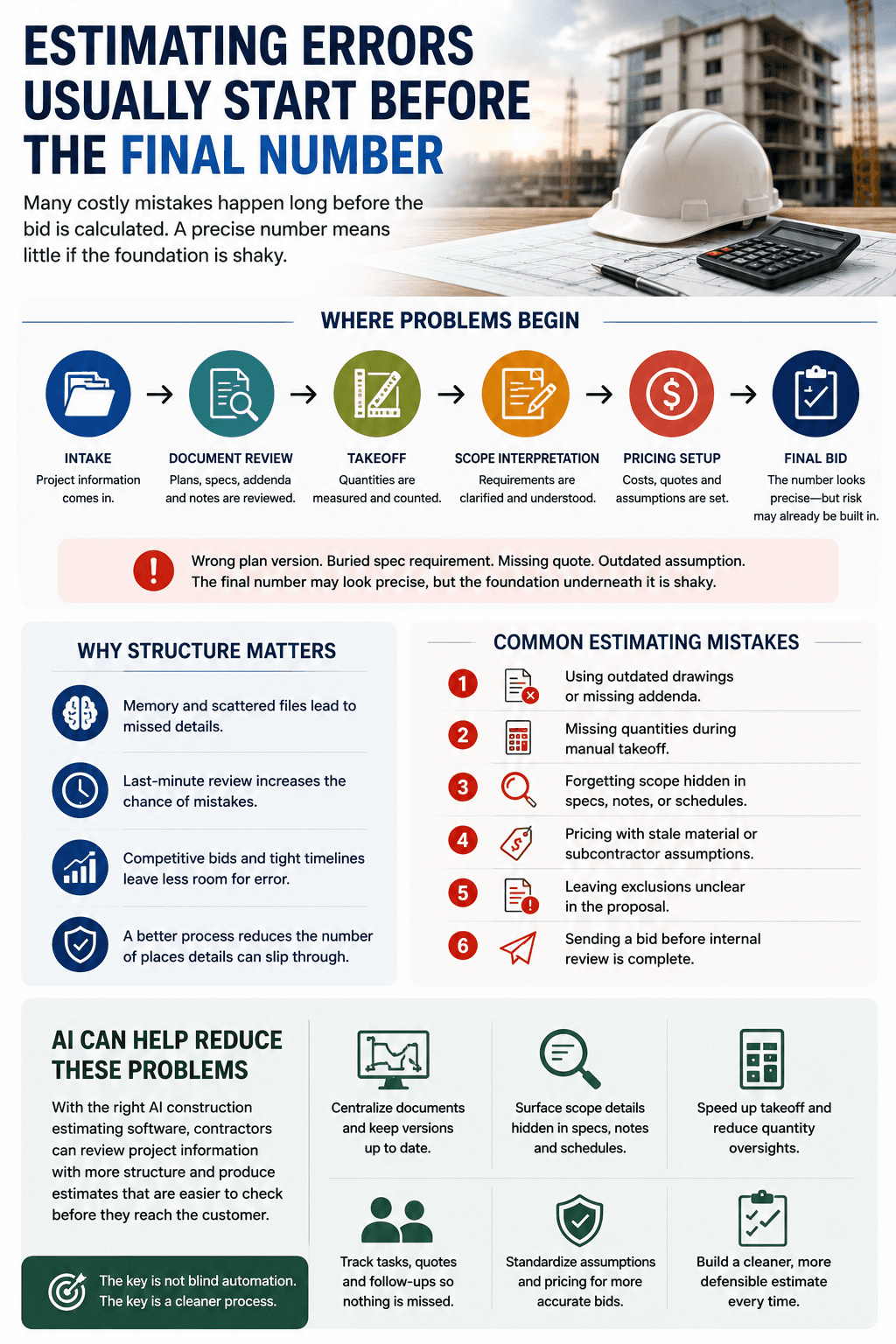
Many estimating mistakes happen long before the final bid is calculated. The problem often starts during intake, document review, takeoff, scope interpretation, or pricing setup. A team may be working from the wrong version of the plan. A spec requirement may be buried in a section nobody had time to review closely. A supplier quote may be missing. A subcontractor assumption may be outdated. The final number may look precise, but the foundation underneath it is shaky.
This is one reason estimating deserves more structure. Contractors cannot rely on memory, scattered files, and last-minute review when bids are getting more competitive and timelines are getting tighter. A better process reduces the number of places where details can slip through.
Common estimating mistakes include:
- Using outdated drawings or missing addenda.
- Missing quantities during manual takeoff.
- Forgetting scope hidden in specs, notes, or schedules.
- Pricing with stale material or subcontractor assumptions.
- Leaving exclusions unclear in the proposal.
- Sending a bid before internal review is complete.
AI can help reduce these problems by streamlining the estimating workflow. With the right AI construction estimating software, contractors can review project information with more structure and produce estimates that are easier to check before they reach the customer. The key is not blind automation. The key is a cleaner process.
Better Document Review Helps Prevent Missed Scope
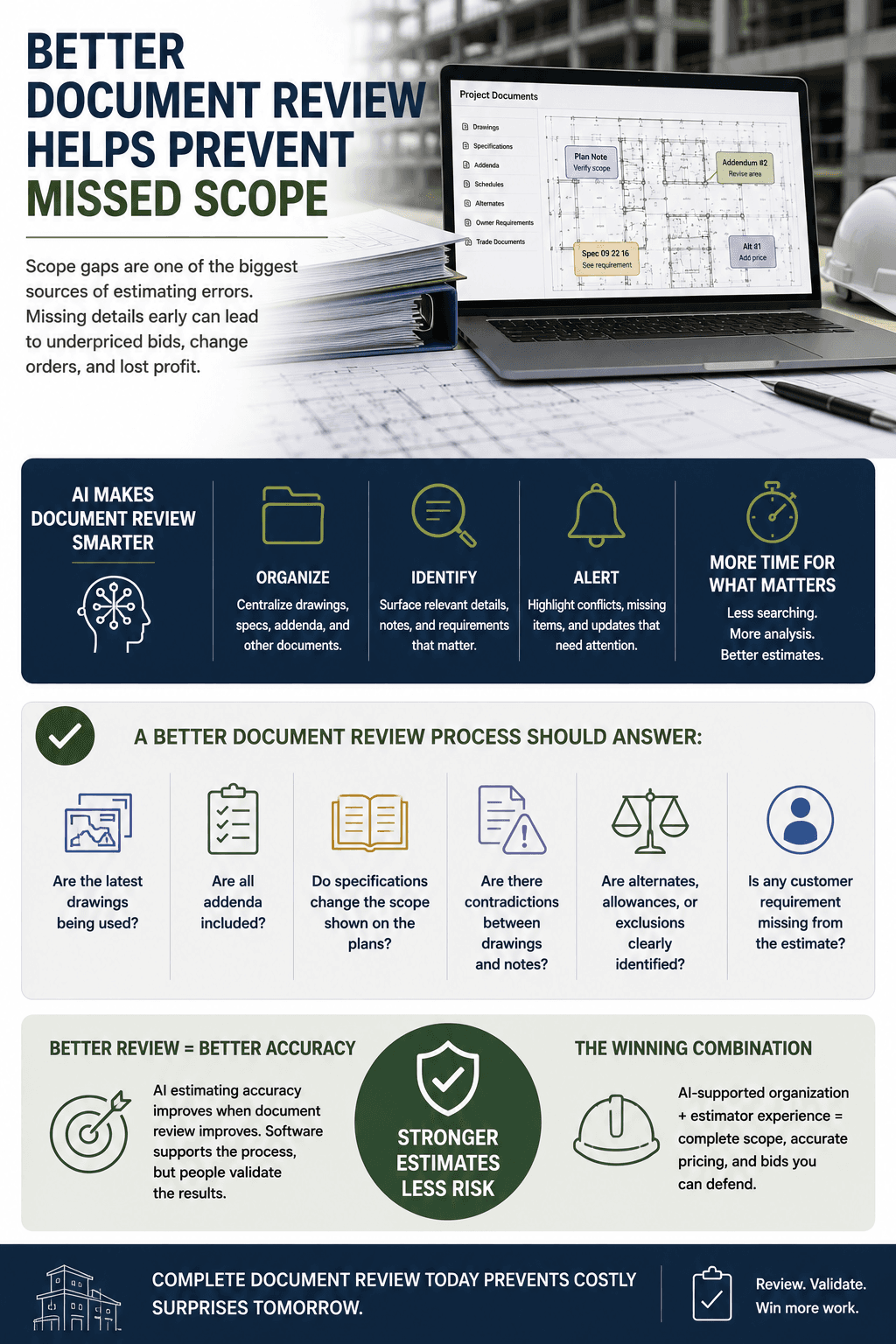
Scope gaps are among the biggest sources of estimating errors. A contractor can measure quickly and still miss the real risk if the scope is incomplete. Important details can appear in plan notes, schedules, specs, alternates, addenda, owner requirements, or trade responsibility language. If those details are missed, the estimate may be underpriced before anyone realizes it.
AI can help estimators review project documents more efficiently. It can support document organization, identify relevant information, and help teams surface details that need attention before pricing is finalized. This gives estimators more time to think through the job instead of spending every minute searching through files.
A better document review process should help contractors answer:
- Are the latest drawings being used?
- Are all addenda included?
- Do specifications change the scope shown on the plans?
- Are there contradictions between drawings and notes?
- Are alternates, allowances, or exclusions clearly identified?
- Is any customer requirement missing from the estimate?
AI estimating accuracy improves when document review improves. Software can support the process, but contractors still need to validate the results. The strongest estimates come from combining AI-supported organization with the experience of someone who understands how the work will actually be built.
AI Makes Takeoff Less Dependent On Repetitive Manual Work
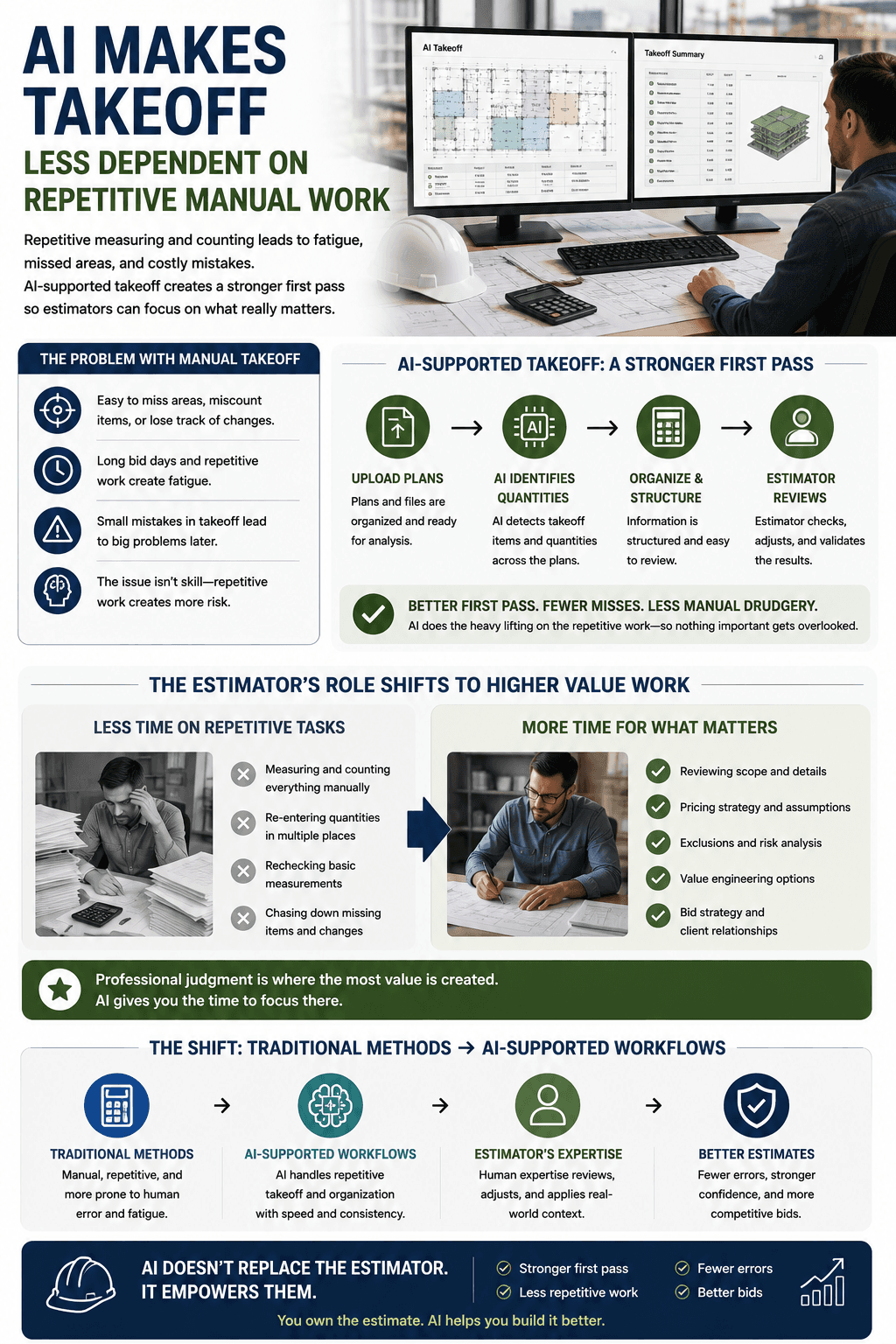
Takeoff is one of the easiest places for estimating mistakes to creep in. Manual measuring and counting takes focus, and long bid days create fatigue. Even experienced estimators can miss an area, miscount an item, or lose track of a change between plan versions. The issue is not skill. The issue is that repetitive work creates more chances for small mistakes to become expensive.
AI-supported takeoff helps reduce that risk by creating a stronger first pass. It can help identify quantities, organize plan information, and provide estimators with a more structured basis for review. The estimator still checks the work, but the process becomes less dependent on manually rebuilding every quantity from scratch.
This changes the estimator’s role in a useful way. Instead of spending most of the time measuring, counting, and rechecking basic inputs, the estimator can focus more attention on scope, pricing, exclusions, risk, and bid strategy. That is where professional judgment has the most value.
The shift from traditional estimating methods to AI-supported workflows does not remove the estimator from the process. Contractors still own the estimate. AI simply helps reduce the repetitive drudgery that often leads to estimation errors.
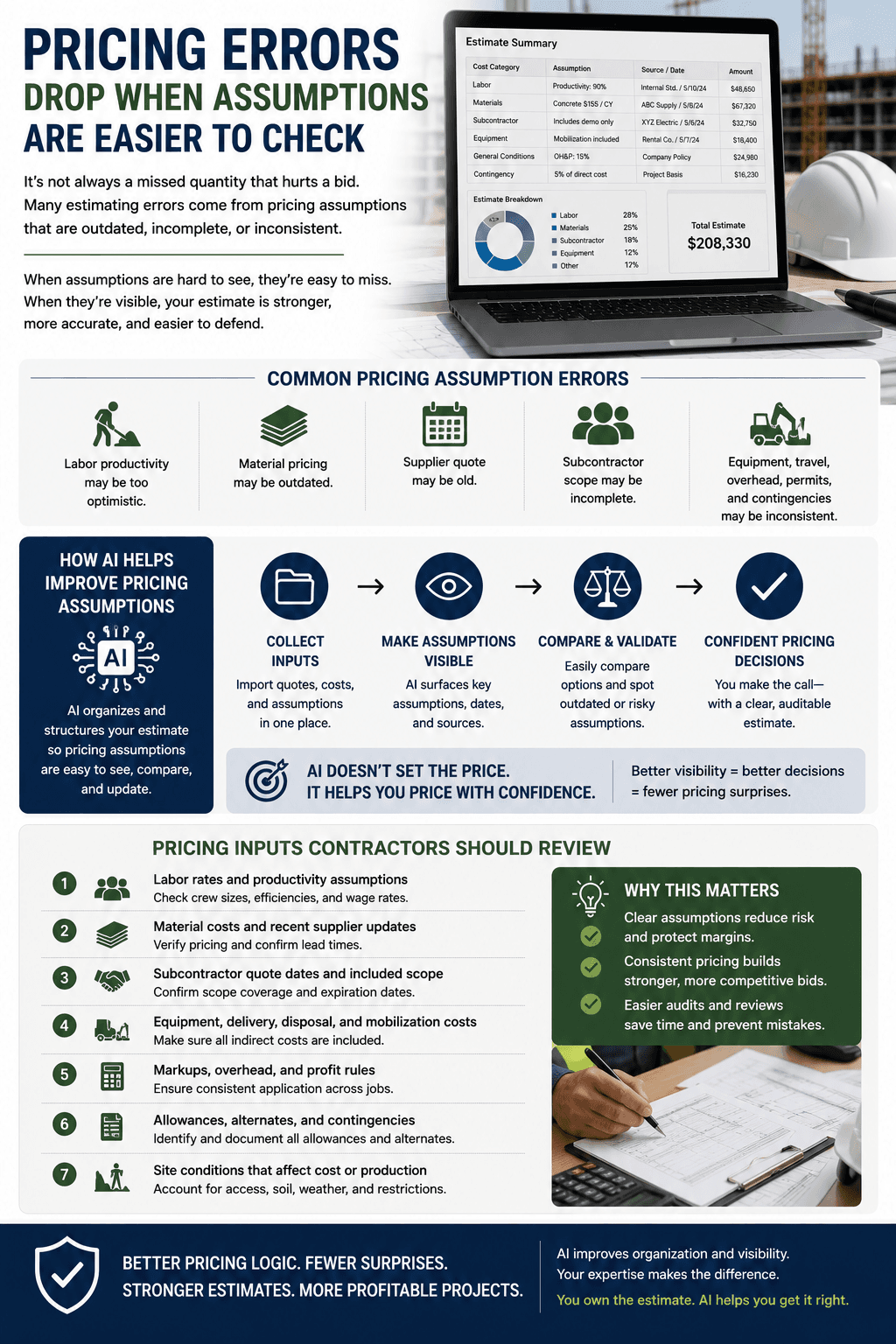
Pricing Errors Drop When Assumptions Are Easier To Check
Not every estimating error is a missed quantity. Many problems come from pricing assumptions. Labor productivity may be too optimistic. Material pricing may be outdated. A supplier quote may be old. A subcontractor number may not include the full scope. Equipment costs, travel, overhead, permits, and contingencies may be handled inconsistently from one estimate to the next.
AI can help organize the estimate so pricing assumptions are easier to review. That does not mean the software magically knows the right price for every job. It means the workflow can make assumptions more visible, easier to compare, and less likely to be hidden in scattered spreadsheets or old templates.
Contractors should review pricing inputs for:
- Labor rates and productivity assumptions.
- Material costs and recent supplier updates.
- Subcontractor quote dates and included scope.
- Equipment, delivery, disposal, and mobilization costs.
- Markups, overhead, and profit rules.
- Allowances, alternates, and contingencies.
- Site conditions that affect cost or production.
Better workflows help contractors keep their pricing logic more organized. The contractor still makes the pricing decision, but AI can help make the estimate easier to audit before it reaches the customer.
Scope Notes And Exclusions Need To Stay Connected To The Estimate
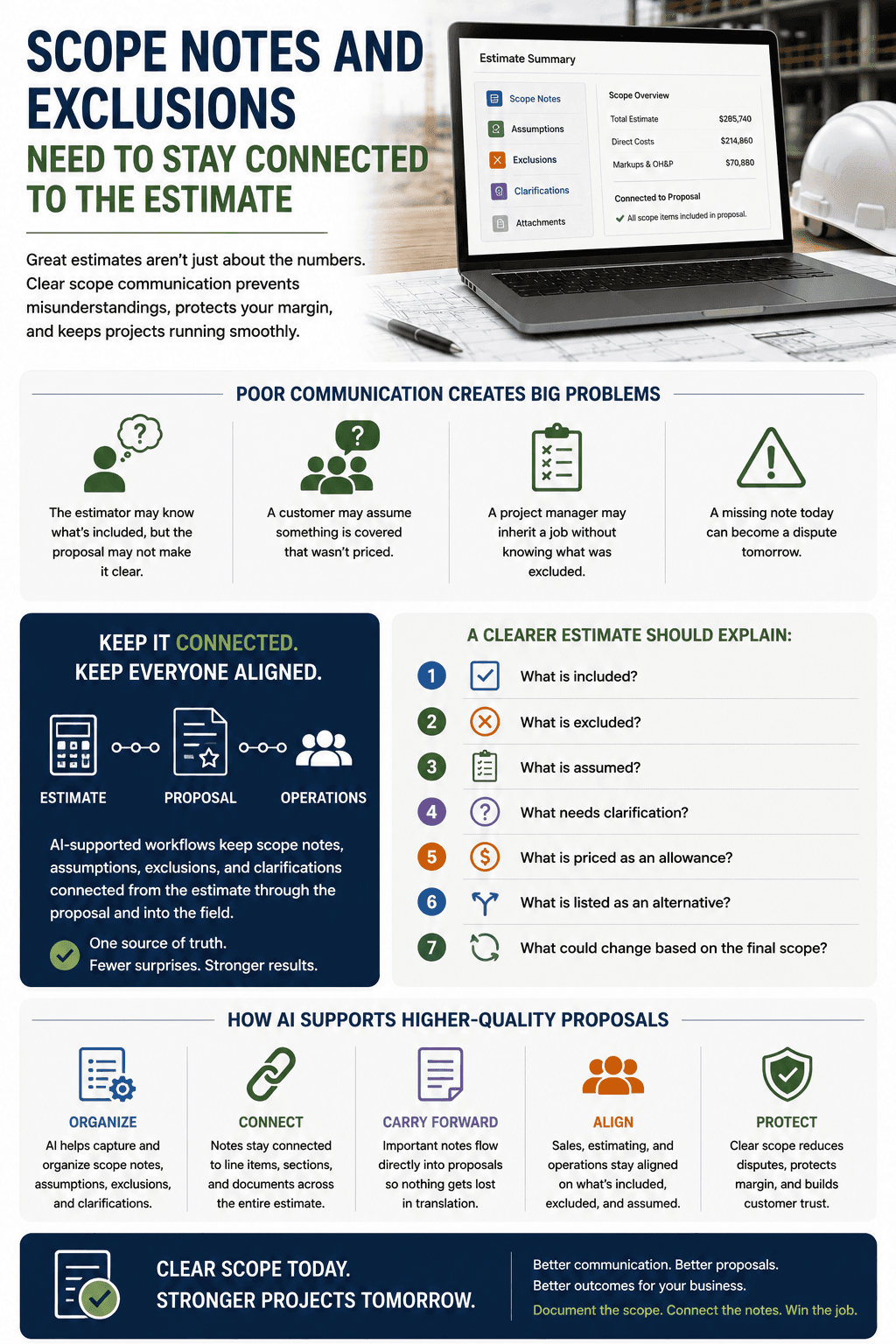
Some estimating mistakes come from poor communication, not bad math. The estimator may understand what is included, but the proposal may not make it clear. A customer may assume something is covered. A project manager may inherit a job without knowing what was excluded. A missing note can become a dispute later.
AI-supported estimating workflows can help keep scope notes, assumptions, exclusions, and clarifications connected to the estimate. That connection matters because the estimate is not only an internal calculation. It becomes part of the sales conversation, the customer expectation, and the handoff to operations.
A clearer estimate should explain:
- What is included?
- What is excluded?
- What is assumed?
- What needs clarification?
- What is priced as an allowance?
- What is listed as an alternative?
- What could change based on the final scope?
This is where AI can support higher-quality proposals. If the system helps organize the estimate and carry important notes into the proposal, the customer receives a clearer picture. Internally, the team has a better record of what was priced and why. That reduces avoidable confusion after the award.
Review Checkpoints Keep AI From Becoming A Shortcut
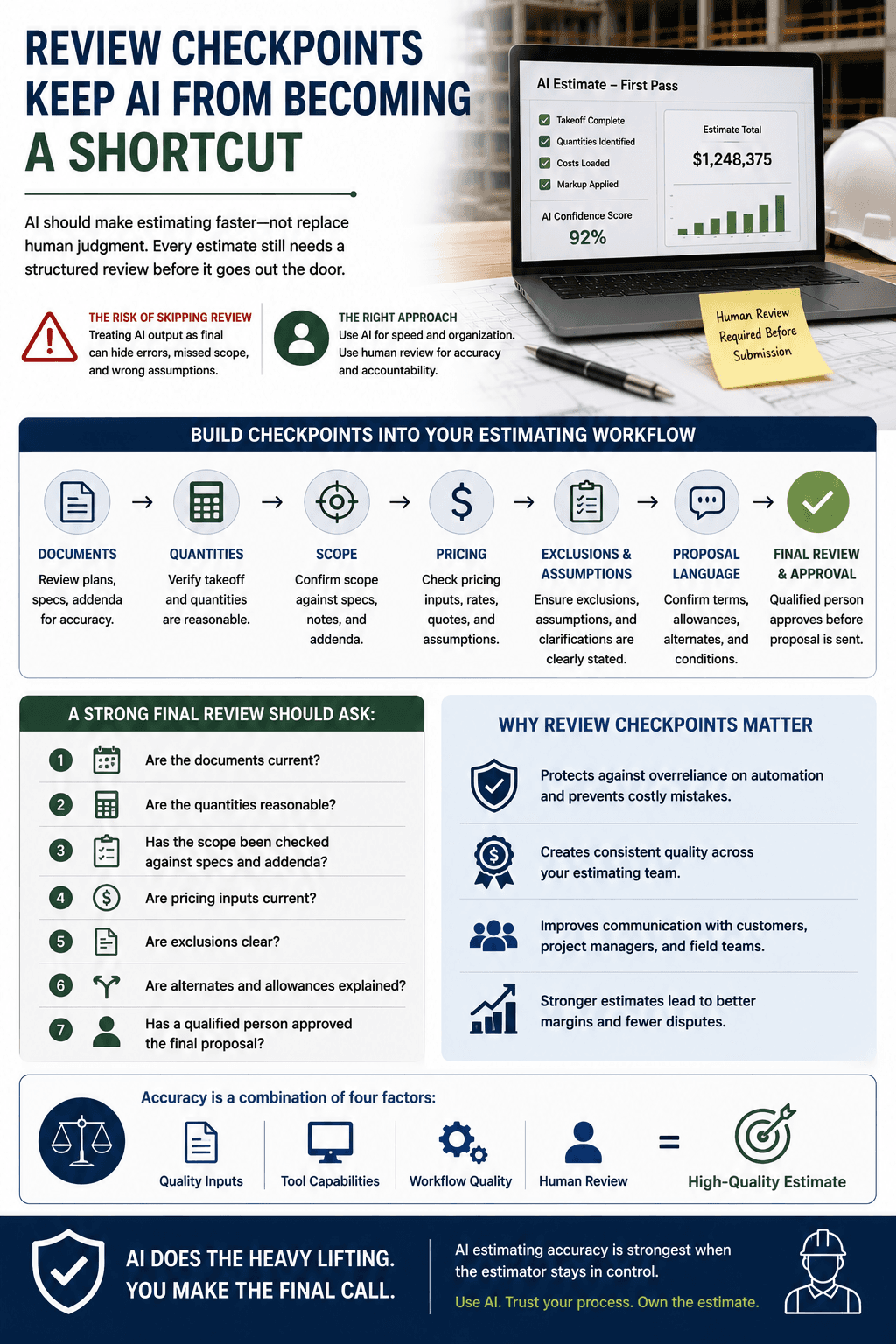
AI should make estimating faster, but it should not become an excuse to skip review. A contractor who treats AI output as final can create a new kind of risk. The software may produce a useful first pass, but every estimate still needs a human review before it goes out. That review should be structured, not casual.
The best teams build checkpoints into the workflow. They review documents, quantities, scope, pricing, exclusions, assumptions, and proposal language before submission. This protects the contractor from overreliance on automation and helps maintain consistent quality across the team.
A strong final review should ask:
- Are the documents current?
- Are the quantities reasonable?
- Has the scope been checked against specs and addenda?
- Are pricing inputs current?
- Are exclusions clear?
- Are alternates and allowances explained?
- Has a qualified person approved the final proposal?
The accuracy of AI-driven construction estimating depends on inputs, tool capabilities, workflow quality, and human review. AI estimating accuracy is strongest when the estimator stays in control of the decision.
Task Management Reduces Missed Steps
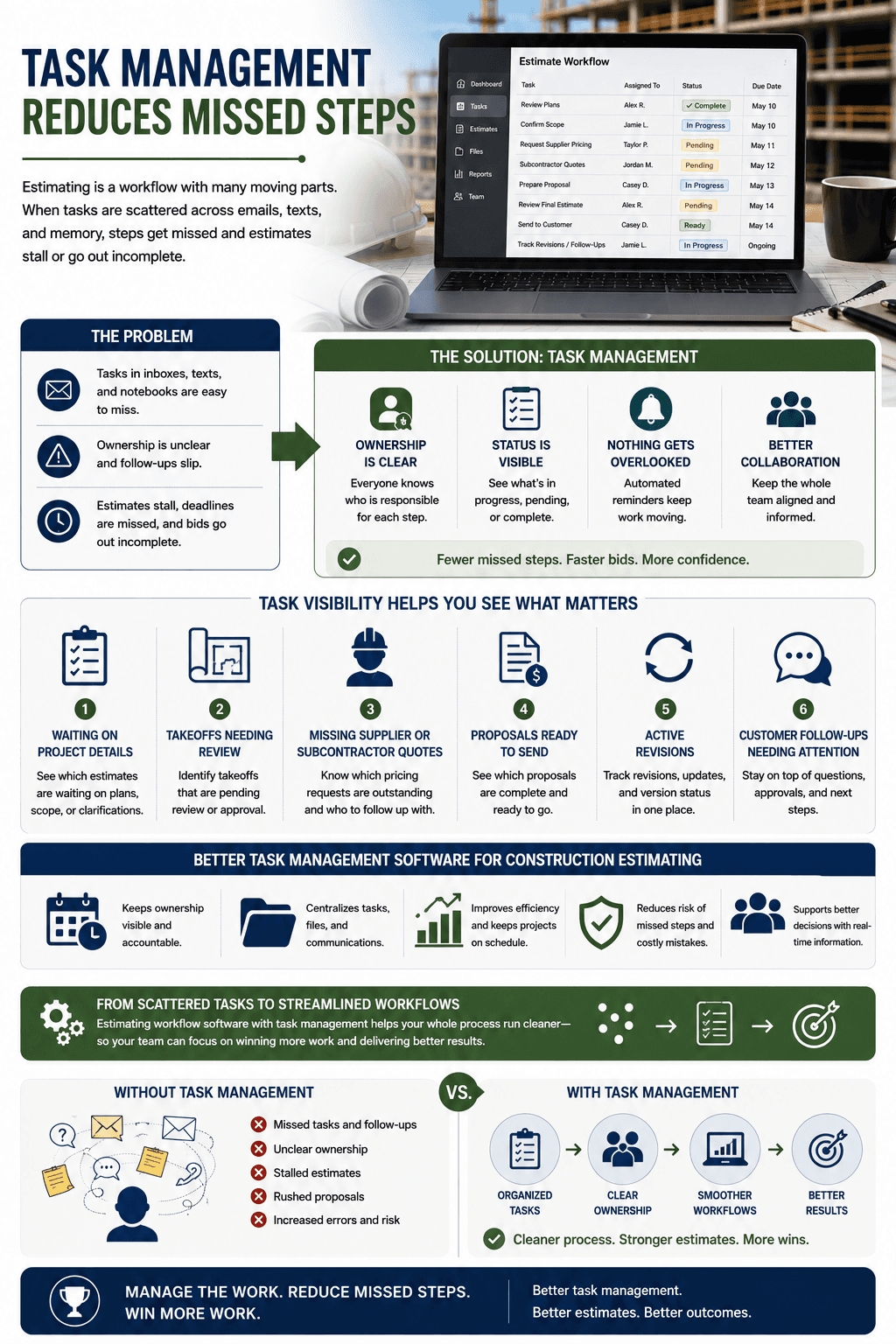
Estimating is not a single task. It is a workflow. Someone needs to review plans, confirm scope, request supplier pricing, follow up with subcontractors, prepare the proposal, review the final estimate, send it to the customer, and track revisions. If those tasks live in inboxes, texts, notebooks, or someone’s memory, the estimate can stall or go out incomplete.
Task management helps contractors reduce missed steps by making ownership visible. The team can see what is waiting on review, which pricing requests are missing, who owns the proposal, and which customer follow-ups are still open. This is especially important when multiple people touch the estimate.
Task visibility helps contractors see:
- Which estimates are still waiting on project details.
- Which takeoffs need review.
- Which supplier or subcontractor quotes are missing.
- Which proposals are ready to send.
- Which revisions are active.
- Which customer follow-ups need attention.
Better task management software for construction estimating helps keep ownership from getting lost in emails or memory. It also reflects a broader shift toward estimating workflow software with task management, where the whole process runs more cleanly, not just the math.
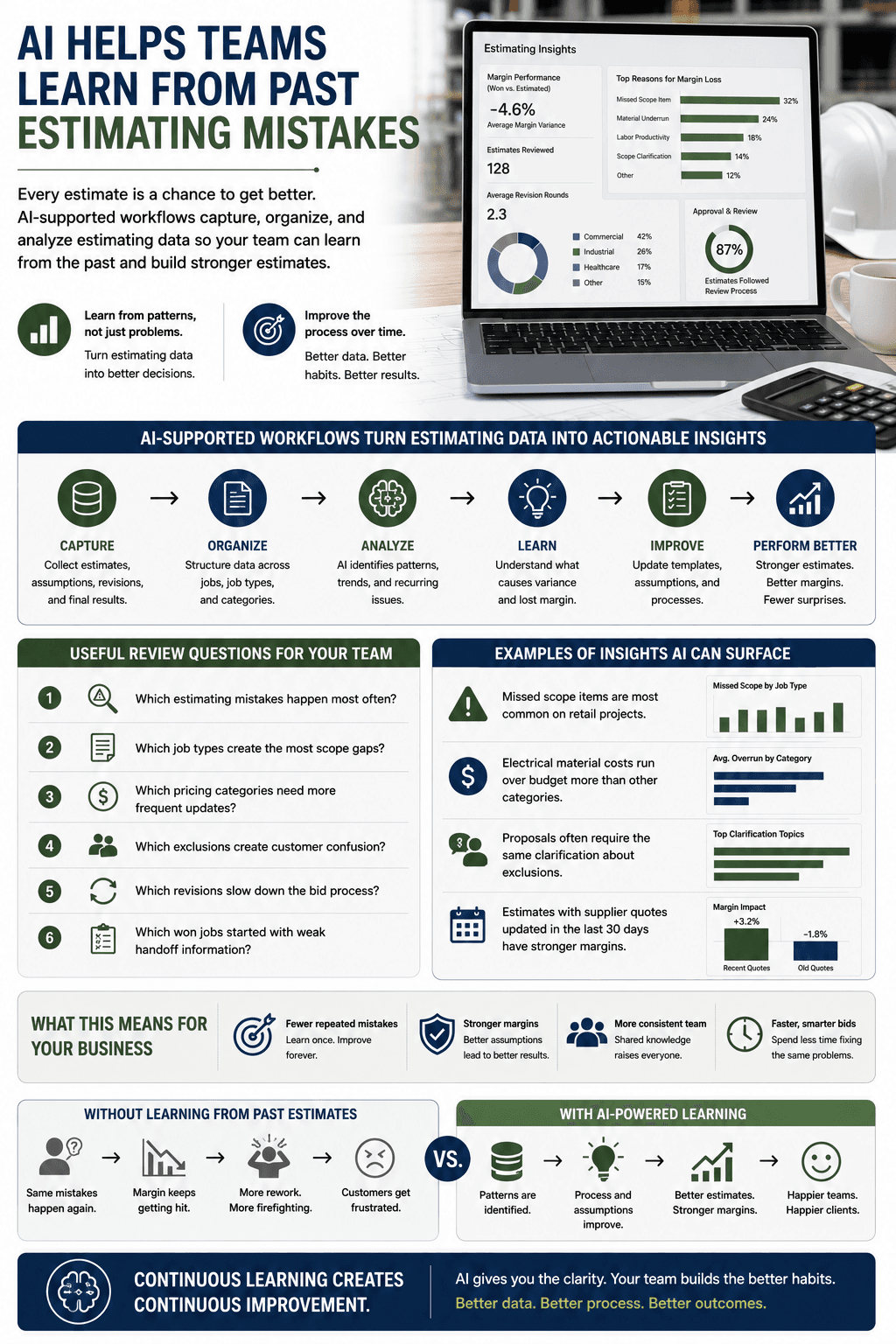
AI Helps Teams Learn From Past Estimating Mistakes
The best contractors do not just fix estimating mistakes one at a time. They learn from them. If a job loses margin because a scope item was missed, that lesson should improve the next estimate. If a certain material category keeps running over budget, the team should revisit its assumptions. If proposals continue to require the same clarification, the template should be improved.
AI-supported workflows can help create a more consistent record of estimates, revisions, assumptions, and outcomes. That makes it easier to spot patterns over time. Contractors can see where estimates tend to drift, where reviews need improvement, and which job types need tighter scope language.
Useful review questions include:
- Which estimating mistakes happen most often?
- Which job types create the most scope gaps?
- Which pricing categories need more frequent updates?
- Which exclusions create customer confusion?
- Which revisions slow down the bid process?
- Which won jobs started with weak handoff information?
A better estimating process should continue to improve. AI gives contractors a cleaner way to structure the work, but the company still has to use that structure to build better habits.
Contractors Still Need Ownership Of The Estimate
AI can help reduce errors, but responsibility stays with the contractor. That is not a downside. It is the way estimating should work. Contractors know the work, the crews, the customers, the market, and the risks. AI helps organize the process, but it does not carry the business judgment that comes from experience.
The best use of AI is practical. Use it to reduce repetitive work. Use it to organize documents. Use it to support takeoff. Use it to catch potential gaps. Use it to make review easier. Then let experienced estimators make the final call.
This balance helps contractors avoid two bad outcomes. One is to ignore AI completely and stay stuck in slow manual workflows. The other is trusting AI too much and sending estimates without enough professional review. The better path is using AI to strengthen the estimator’s process.
Reduce Estimating Errors With A Cleaner QuoteGoat Workflow
Estimating mistakes do not have to be treated like a normal cost of doing business. Contractors can reduce missed scope, outdated assumptions, manual takeoff errors, unclear exclusions, and stalled reviews with a better workflow.
QuoteGoat helps contractors build cleaner AI-supported estimating systems around document review, takeoff, scope checks, task visibility, proposal creation, and final review. If your team is still relying on scattered files, manual setup, and rushed bid checks, it may be time to tighten the process and give estimators a better way to work. Learn more about QuoteGoat AI Construction Estimating Software.