
Residential Vs Commercial Estimating: Which AI Tools Actually Fit Your Business

Dhyna PhilsHead of Marketing
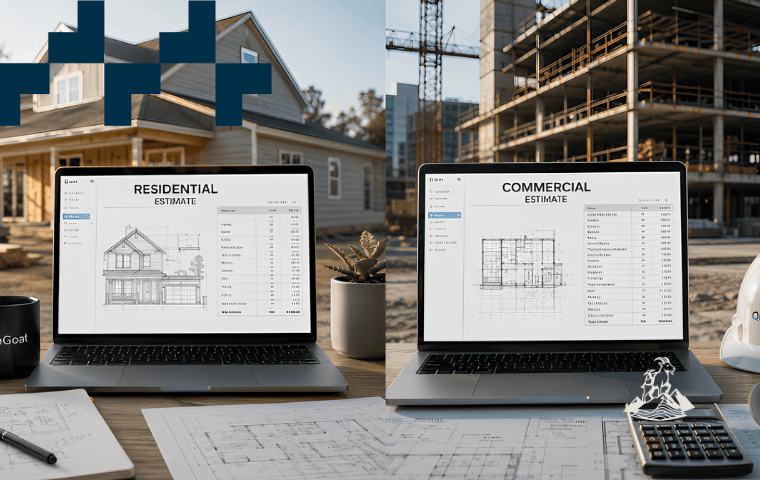
If you build residential projects, your estimating world probably feels fast, personal, and a little chaotic in the best and worst ways. If you bid commercial work, the pace might be slower, but the pressure shows up in different places: documentation, coordination, and the kind of details that can turn a "good number" into a painful job. A lot of software claims it can handle both, yet the real question isn't whether a tool can produce a total. The question is whether it supports how each type of project actually gets sold, scoped, and executed.
At QuoteGoat, we see contractors run into the same trap over and over: they try to force one estimating workflow across two very different job types. That's where scope gets missed, revisions get sloppy, and estimates stop matching the way the field runs the work.If you're comparing residential and commercial tools, or you're trying to use one system across both, this guide lays out the practical differences and how to think about them when considering AI estimating software for your business.
The Core Difference Between Residential And Commercial Estimating
Residential estimating is often built around speed, trust, and communication. You're pricing a job for someone who may never have hired a contractor before, and their decisions can change the scope in real time. Even if you're working with an architect or designer, residential projects still carry a lot of gray area: finishes, unknown conditions, and owner preferences that evolve once walls open up.
Commercial estimating is built around documentation, structure, and defensibility. You're usually pricing against plan sets, specs, addenda, bid forms, alternates, and a stack of rules that define what you can and can't assume. The "customer" might be a GC, a facility manager, a procurement team, or a public entity. Communication is formal, and your estimate needs to stand up to scrutiny from multiple angles.
That's the lens we use for residential vs commercial estimating AI. It's not about which one is "harder." It's about which risks are most likely to hit you, and whether the software helps you spot them early instead of cleaning them up after the fact.
What You're Estimating From: Inputs And Documentation
Residential inputs are often incomplete, inconsistent, or informal. Sometimes you get a clean set of plans. Often, you get partial drawings, photos, a few measurements, and a quick conversation that turns into scope. Remodels are the classic example: you can't see what you're really dealing with until demo reveals it.
Commercial inputs tend to be formal and comprehensive, yet they're also loaded with traps. You might have everything you need in the plan set, but the details are spread across disciplines, specs, and addenda that keep changing as bid day approaches. The work isn't just takeoff. It's managing information.
Here are the most common input gaps that show up differently in each world.
- Residential drawings might be missing dimensions, which can quietly inflate labor costs once framing starts and things don't line up.
- Residential remodels often rely on allowances early, which can lead to margin erosion if selections aren't controlled.
- Commercial plan sets can be complete on paper, yet addenda can invalidate your earlier assumptions in minutes.
- Commercial specs can impose materials, methods, or performance requirements that don't appear in the drawings, and missed spec details can become expensive change disputes later.
Scope Complexity Looks Different In Each Project Type
Residential complexity is usually personal and situational. Every house is its own puzzle. Even new builds vary based on site conditions, client expectations, and the reality that homeowners change their minds. The complexity isn't always in the drawings. It's in the context.
Commercial complexity is systemic. You're working inside assemblies, systems, and coordinated scopes. A small miss can ripple across trades. Access constraints, safety plans, phasing, and schedule requirements can turn a straightforward scope into a production problem. The job might be documented, yet execution is where the complexity shows up.
This is where AI construction estimating should be evaluated on more than speed. Fast takeoff is helpful, but scope coverage is the feature that protects you. Contractors don't lose money because their number took too long to build. They lose money because something important wasn't included, or it was included with the wrong assumption.
We talk a lot about scope confidence as the real output, not just an estimated total. If you want the mindset behind that, this article aligns with how we think about reducing missed scope rather than just shaving minutes.
Labor And Production Rates: The Assumptions Don't Travel Well
Residential labor assumptions are heavily influenced by the crew, the client, and the house itself. Travel time can matter more. Protection and cleanup often take longer than expected. Working inside someone's home changes the production rate even for simple tasks. You can also have high variability between projects because the conditions aren't standardized.
Commercial labor assumptions are shaped by access, schedule, supervision, and coordination. You might need more foreman time, more safety compliance, and more staging. The jobsite rules can be strict, and the schedule can compress in ways that add cost even if quantities don't change. In some markets and project types, wage requirements and paperwork can also affect labor cost structure.
Software should make it easy to adjust these assumptions without turning your estimating process into a spreadsheet rebuild every time the job type changes. The best workflow supports repeatable logic while still letting you override production rates where reality demands it.
Pricing Structure Differences: Allowances Versus Line-Item Depth
Residential pricing often needs to be client-friendly. Even if your internal estimate is detailed, the presented version is frequently grouped into phases, systems, or rooms. Allowances are common because the early scope is often conceptual. Change orders are expected, and your estimate needs to make that process clean rather than combative.
Commercial pricing usually rewards detail and structure. Bid forms can require specific breakouts. Alternates and unit prices may be mandatory. You may need to level subcontractor quotes and document inclusions and exclusions precisely. Presentation matters, but defensibility matters more.
Accuracy plays out differently across formats. Residential accuracy is partly about managing expectations and controlling selections. Commercial accuracy is about aligning scope interpretation with the bid documents and protecting yourself from ambiguity.

Risk And Contingency: Different Projects Hide Different Problems
Residential risk often hides in unknown conditions and owner-driven changes. You can't always price what you can't see. You also have a risk tied to decision speed. A slow decision on tile, cabinets, or fixtures can create schedule drag that becomes labor creep, coordination cost, and frustration that eats profit.
Commercial risk hides in coordination and compliance. You can have a clean scope, then lose money because the jobsite conditions make production slower than planned. You can also have disputes that come down to the interpretation of a spec or drawing note. Procurement risk is real, too. Long lead equipment and submittal cycles can reshape the schedule and cost.
Here are risk signals worth flagging early in each job type.
- Residential: older homes, partial drawings, client-supplied materials, tight access, and high-end finishes that increase rework risk.
- Commercial: heavy addenda volume, multiple alternates, incomplete specs, long lead materials, and unclear responsibility boundaries between trades.
This is also where workflow automation can help, not as a magic button, but as a way to keep scope and revisions organized.
Workflow And Speed: Where AI Helps Fast, And Where Humans Still Win
AI-driven estimating can help in both residential and commercial settings, but its value manifests at different points. In residential work, the biggest speed win is producing a credible first draft estimate quickly, even when inputs are messy. That speed isn't just about saving time. It helps you respond to leads while they're still engaged and iterate as the scope becomes clearer. Residential projects often involve multiple revisions before a contract is signed, and the contractor who can revise fast without losing scope control has an edge.
In commercial work, speed is usually less about the first draft and more about managing complexity over time. Bid cycles include plan revisions, addenda, scope clarifications, subcontractor quote updates, and last-minute changes that can wreck a fragile workflow. AI-supported organization and structured estimate building can reduce the scramble, especially when you're managing multiple bids at once.
What doesn't change is the need for judgment. Estimating is still a combination of measurement, experience, and risk management. AI can accelerate the process, yet you still need a real estimator's eye to validate assumptions and catch job-specific issues.
Collaboration And Handoffs: Who You're Coordinating With Changes Everything
Residential collaboration is usually direct and conversational. You're coordinating with homeowners, designers, and maybe an architect. You're also coordinating internally with your own team to ensure the estimate matches how you'll actually build the job. Communication has to be clear, and the estimate often needs to support sales as much as it supports operations.
Commercial collaboration is structured and multi-layered. You're dealing with GCs, subs, vendors, and possibly procurement teams. Scope leveling becomes a job of its own. Documentation, compliance, and bid requirements often dictate how you present the estimate. Clear handoffs between estimating and project management are critical because the project team needs to understand what was assumed, excluded, or carried as an allowance.
This is where estimating connects to task flow and internal accountability. If you're thinking about the operational side, efficient task management fits into the conversation of keeping your team aligned from estimate to execution.
What To Look For In AI Estimating Software For Each Project Type
There are shared needs across residential and commercial estimating. You want speed, consistency, scope coverage, and outputs you can actually use. Past that, the needs diverge based on how you sell, document, and run the work.
Shared must-haves across both project types:
- Strong scope organization that helps prevent missed work, not just faster math.
- Clear assumptions that you can review, adjust, and standardize across your team.
- Revision control that doesn't force you to rebuild estimates from scratch.
- Outputs that can be shared internally, presented externally, and used as the basis for project setup.
Residential-focused needs:
- Templates that match common job types, so you can quote consistently without sounding generic.
- Allowance controls that keep selections from turning into uncontrolled cost creep.
- Change-order-friendly breakdowns that support client conversations without endless reformatting.
- Client-ready summaries that explain what's included without forcing you to overshare every line item.
Commercial-focused needs:
- Addenda handling and revision discipline to ensure changes don't get missed under deadline pressure.
- Alternate structures and bid form alignment that map to how commercial bids are evaluated.
- Audit trail visibility, so your team can defend the estimated decisions if questions come up.
- Deeper line-item options for scopes that require it, especially where coordination and compliance are sensitive.
If you're evaluating tools, use questions like these in demos and internal reviews:
- Can the estimated output match how we sell jobs and how we run jobs?
- Can we handle revisions quickly without losing track of what changed?
- Does it help prevent missed scope, or does it only speed up takeoff?
- Can we standardize assumptions without locking ourselves into bad defaults?
- Can the system support both quick budgets and detailed bid-ready estimates?
For a broader context on how AI is reshaping the category and what contractors should watch for, these are worth scanning alongside your evaluation:

Residential Vs Commercial Estimating AI: How QuoteGoat Approaches The Real-World Mix
Most contractors don't live in a neat box. You might run primarily residential projects and take the right commercial job when it fits. You might do light commercial and still bid higher-end residential remodels. The tool you choose needs to support that mix without forcing you to rebuild your workflow each time your job type shifts.
QuoteGoat is built around practical estimating workflows that help contractors move faster while staying disciplined about scope. The goal isn't to replace estimator judgment. The goal is to give you a cleaner, more repeatable process that reduces missed scope, supports revisions, and keeps your team aligned as you scale.
If your work spans residential and commercial jobs, your estimating workflow needs to flex without falling apart. Explore QuoteGoat and then compare what modern tools prioritize in the current market.