
AI Construction Takeoff Software: How Contractors Build Faster, Cleaner, More Defensible Estimates

Dhyna PhilsHead of Marketing
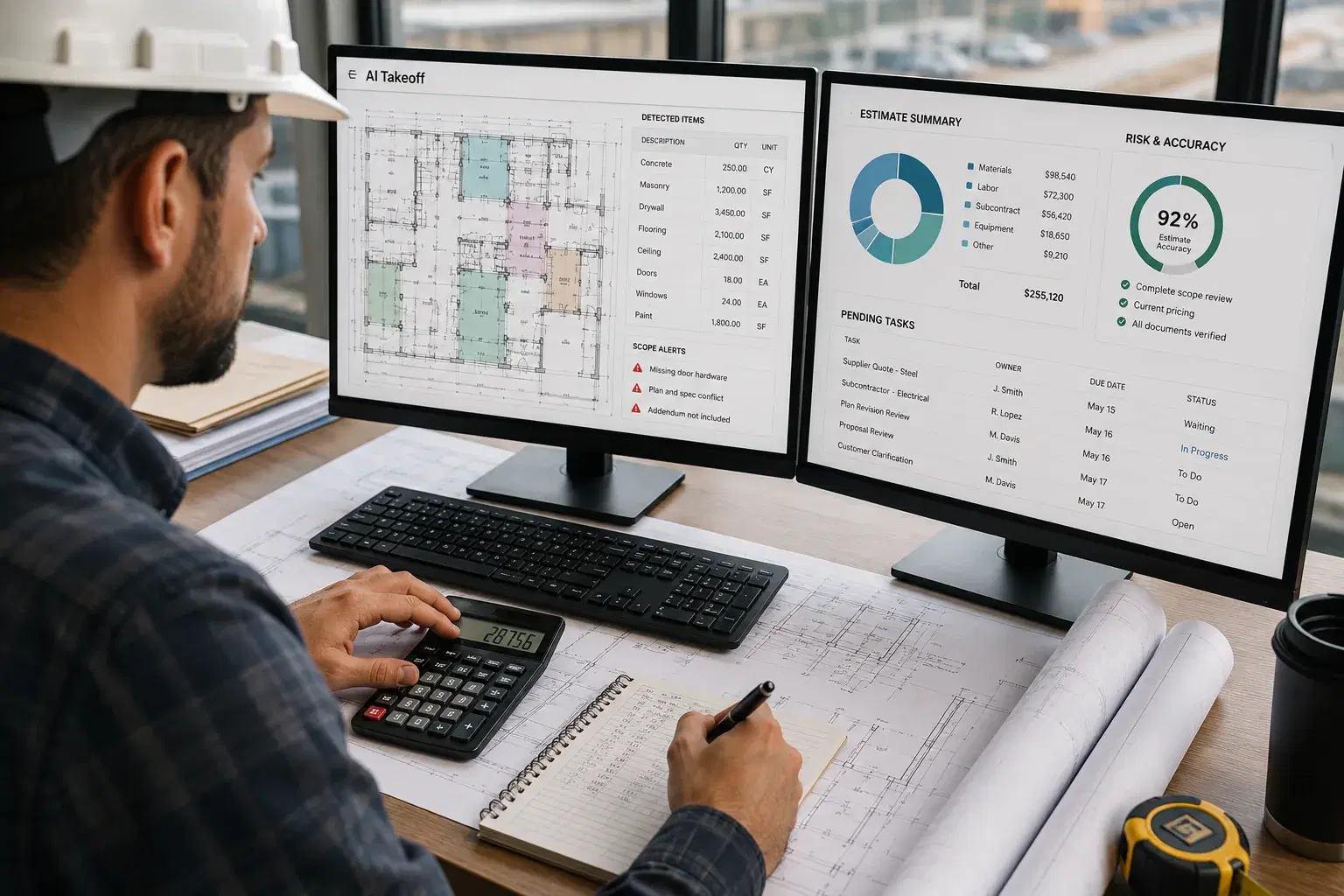
Estimating pressure hits before bid day ever arrives. Contractors are reviewing plans, checking quantities, reading specs, tracking addenda, confirming scope, chasing supplier input, and trying to deliver a bid that is fast enough to compete and strong enough to defend. The old process still works for some teams, but it often asks estimators to carry too much manual work on tight deadlines.
That is where AI construction takeoff software changes the conversation. The value is not just faster measurement. The greater value is helping estimators reduce repetitive work, catch scope issues earlier, organize project information more clearly, and maintain control of the estimate before numbers are locked in. Contractors still own the final bid. The software helps them get there with less drag and more confidence.
What AI Takeoff Actually Changes For Contractors
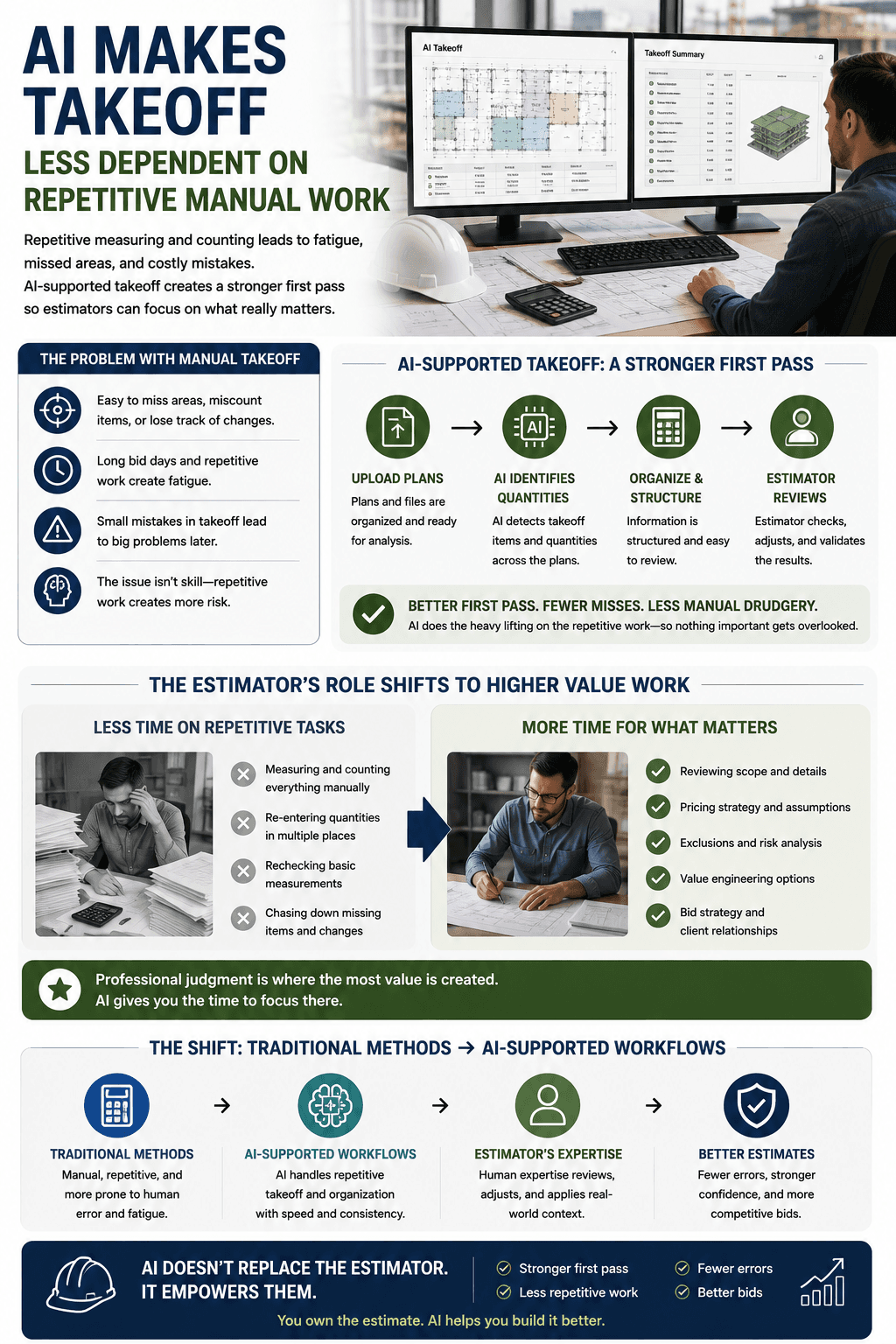
Takeoff has always been one of the most time-heavy parts of estimating. Contractors have to read plan sheets, measure areas, count items, compare drawings with specifications, check schedules, and ensure the quantities make sense for the scope being priced. That work takes focus, and under deadline pressure, it can become a bottleneck.
AI changes the front end of that workflow. Instead of forcing estimators to spend hours on repetitive measuring and counting, the software can help identify project information, organize quantities, and create a more structured starting point for review. The estimator still needs to validate the work, but the first pass can move much faster.
This does not mean contractors should treat the output as final. Construction estimating still needs judgment. An experienced estimator understands trade conditions, field realities, supplier reliability, labor assumptions, exclusions, and risk. AI can support the workflow, but it cannot replace the decision-making that comes from knowing how work is actually built.
The practical shift looks like this:
- Manual takeoff work becomes less dependent on repetitive measuring.
- Plan review becomes easier to organize across sheets, specs, and addenda.
- Estimators gain more time for pricing, scope review, and risk decisions.
- The contractor still owns final judgment, assumptions, and bid strategy.
Why Takeoff Accuracy Starts With Better Inputs
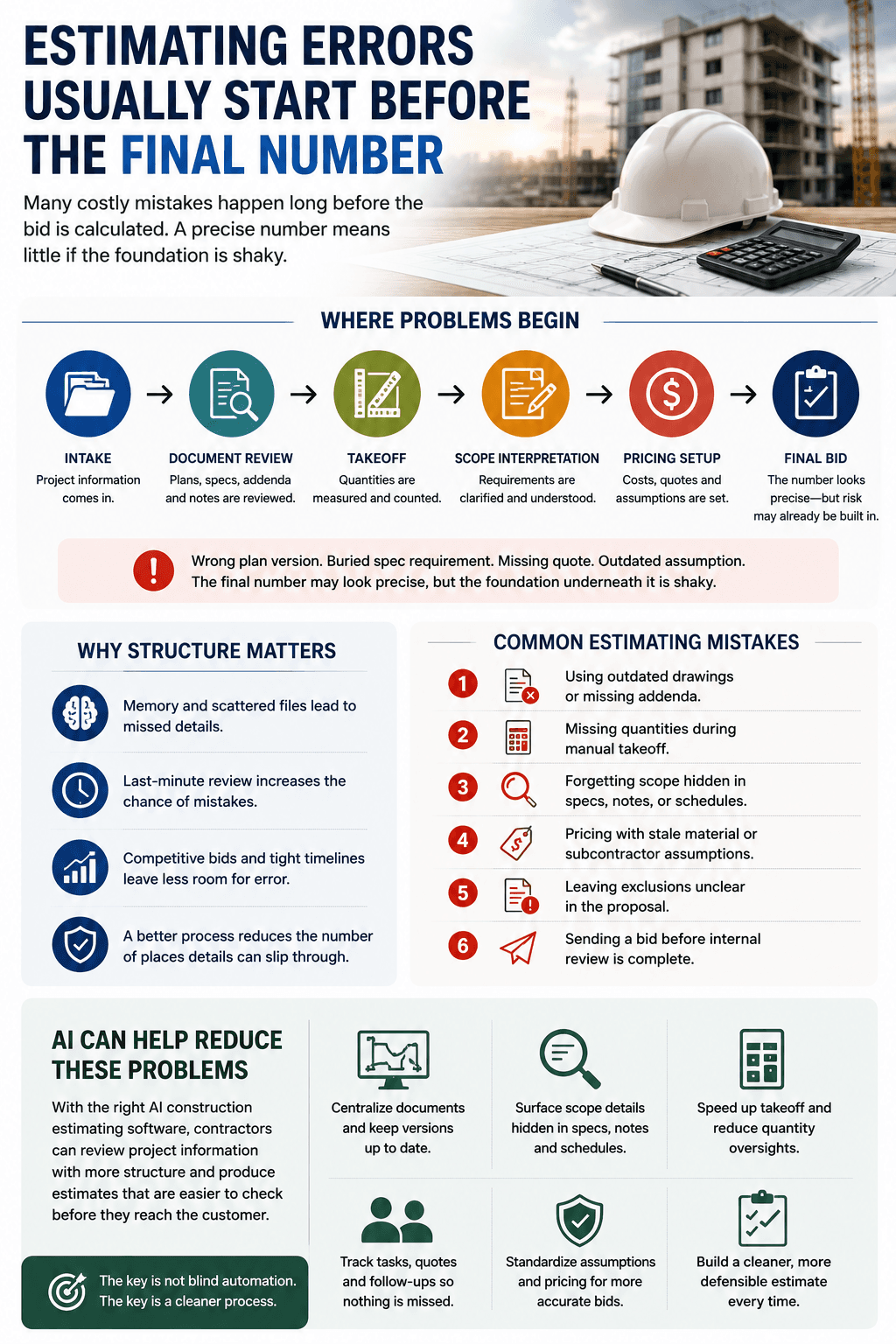
AI can speed up takeoff, but speed does not eliminate the need for clean project documents. If the plan set is outdated, the specs are missing, an addendum is not included, or drawings are mislabeled, the estimate starts with risk before anyone measures a thing. Better software does not change the basic rule: better inputs lead to better review.
Contractors need a disciplined intake process before they rely on AI-supported takeoff. That means confirming current drawings, gathering specifications, uploading addenda, collecting customer notes, and organizing project files in a way the team can understand. If the estimator has to stop halfway through the process to chase missing documents, the workflow loses momentum.
The best estimating teams do not treat AI like a shortcut around document control. They use it as a reason to tighten document control. Current files should be labeled clearly. Old versions should not drive the estimate. Addenda should be included as soon as they arrive. Specifications should be reviewed alongside drawings, not after the pricing is already built.
Accuracy also depends on the review process that follows the software's creation of a starting point. Estimators should check quantities, confirm scope, review assumptions, and compare the output against the job’s actual conditions.
Scope Gaps Are The Real Estimating Risk
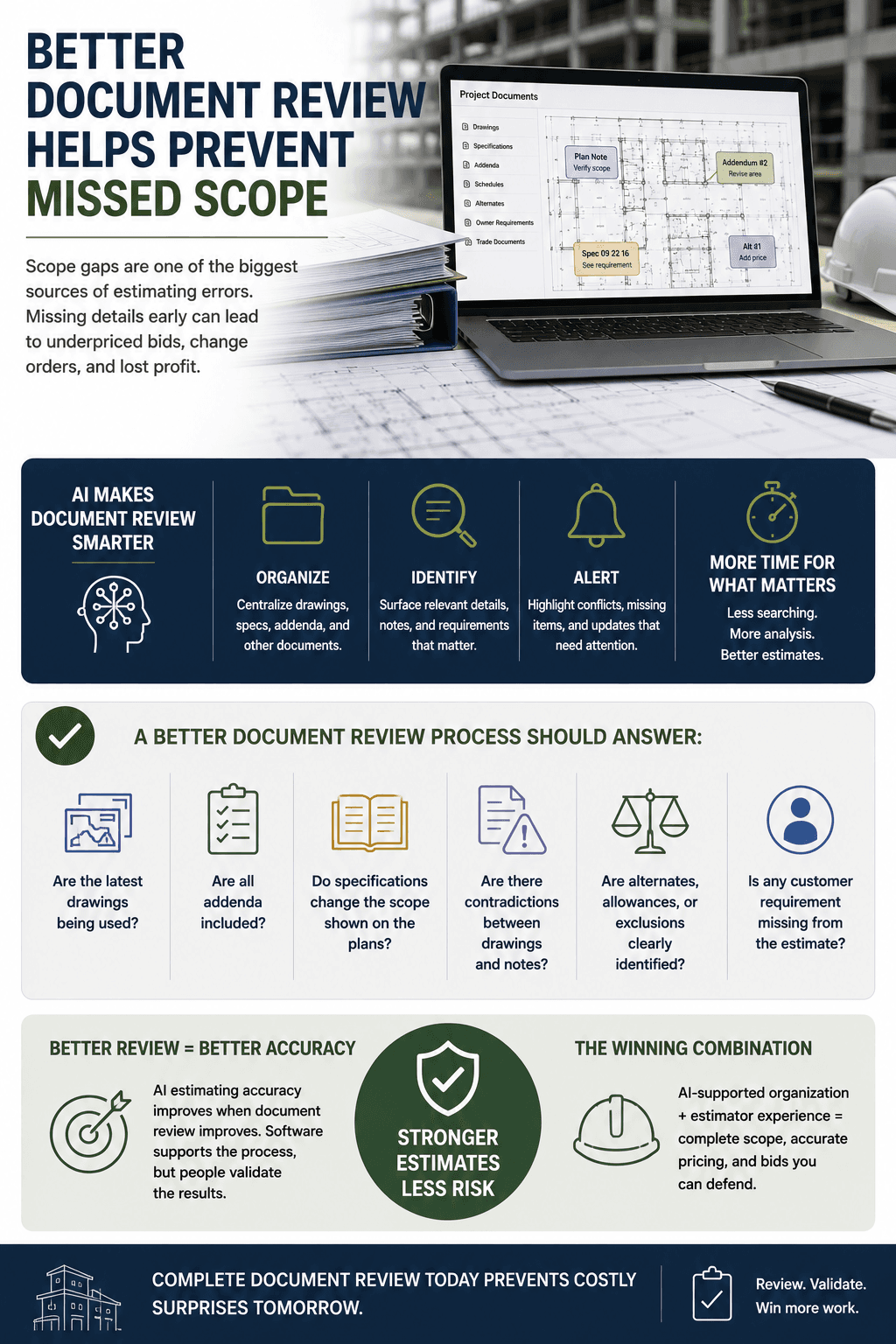
A takeoff can be fast and still miss the point if the scope is not complete. Contractors often lose money because something was left out, misunderstood, buried in the specs, changed in an addendum, or assumed by one party but not priced by another. A missed quantity matters, but a missed scope requirement can hurt the entire job.
Scope can hide in places estimators do not have time to review carefully enough. Notes, schedules, specifications, alternates, plan revisions, owner requirements, and trade responsibilities can all carry important details. If the workflow is rushed, those details can slip through. The estimate may look complete on the surface while carrying problems underneath.
That is why takeoff software should do more than count and measure. It should support scope review. Contractors need tools that help organize documents, surface relevant information, and keep the estimator focused on what needs attention before bid day. The goal is not to remove review. The goal is to make review sharper and less dependent on memory.
Common scope risks include:
- Scope can hide in notes, schedules, specifications, and addenda.
- Contradictions across documents can create pricing exposure.
- Missed trade boundaries can lead to disputes after award.
- A faster takeoff still needs a strong scope review.
- More complete estimates are easier to defend internally and externally.
Faster Takeoffs Should Not Mean Sloppy Bids
Speed is one of the clearest benefits of AI-supported takeoff. Estimators can move through quantities faster, review more opportunities, and reduce the late-night pressure that comes with manual plan work. For contractors managing several bids at once, that speed can make a real difference.
Still, a faster estimate is only valuable if it is still complete, reviewed, and easy to explain. Contractors do not win in the long term by rushing out weak numbers. A sloppy bid can create margin problems, customer confusion, scope disputes, and painful change conversations after the job starts. Speed needs structure behind it.
A strong process uses faster takeoff to create more room for better estimating decisions. If software reduces repetitive measuring, the estimator can spend more time checking scope, confirming pricing, writing exclusions, reviewing risk, and preparing a clearer proposal. That is the kind of speed that helps a contractor, because it improves the process instead of simply compressing it.
Contractors should treat AI-supported takeoff as the beginning of review, not the end of estimating. Quantities need to be validated. Pricing logic needs to be checked. Assumptions need to be documented. Clarifications need to be written clearly. Faster bidding works best when it gives teams more control, not less.
How AI Takeoff Supports A Better Estimating Workflow
Takeoff is only one part of estimating. A real estimate includes lead intake, document review, quantity takeoff, scope validation, supplier or subcontractor input, cost assumptions, exclusions, proposal creation, internal review, revisions, and follow-up. If the takeoff is faster but everything around it is still scattered, the process can still break down.
A stronger workflow keeps the estimate organized from the first document upload to the final proposal. Plans, specs, notes, quantities, assumptions, scope comments, and revisions should not live in separate places with no clear owner. That is how teams lose time and miss details.
AI-supported takeoff works best when it is integrated into a cleaner estimating system. The contractor uploads documents, reviews AI-supported quantities, checks scope, adjusts the estimate, prepares the proposal, and tracks what still needs attention. The workflow becomes easier to manage because each step is connected to the next.
A better estimating workflow should support:
- Plans and supporting documents living in one organized workspace.
- Quantities that are easier to review, adjust, and validate.
- Scope notes staying connected to the estimate.
- Revisions that are easier to track when plans or assumptions change.
- Proposal preparation that does not require rebuilding the estimate from scratch.
Automation is not just about doing one task faster. It is about reducing friction across the entire estimating workflow so contractors can move from project information to a defensible proposal with fewer gaps.
Residential Contractors Can Benefit From Repeatable Takeoff Workflows
Residential contractors often deal with a unique kind of pressure. Customers expect fast answers, leads can come in quickly, and many project types have familiar patterns with job-specific details. Remodelers, roofers, flooring companies, painters, concrete contractors, exterior contractors, and specialty trades often estimate similar categories of work, but each job still needs its own review.
That repeatability makes AI-supported takeoff useful. A contractor can create a more consistent estimating process without treating every project like a copy of the last one. The software can help reduce repetitive setup, organize quantities, and support clearer proposals, while the estimator still reviews site conditions, customer requests, scope changes, and pricing assumptions.
Residential customers also benefit from clarity. A clean estimate helps the customer understand what is included, what is excluded, what assumptions were made, and what could change. A messy estimate can create doubt even if the price is fair.
Residential work is not simple. It can involve emotional customers, tight budgets, site surprises, and constant changes. A better takeoff workflow gives contractors more room to handle those realities without having to rebuild every estimate from scratch.
Commercial And Specialty Contractors Need Better Scope Control
Commercial and specialty contractors often face heavier document sets and more complicated bid requirements. Plans, specs, addenda, alternates, trade coordination, exclusions, and owner requirements can create layers of risk. A takeoff may produce quantities, but the estimator still needs to understand what those quantities mean inside the larger bid package.
For these teams, AI-supported takeoff can help reduce manual measurement time while improving organization. The estimator can spend less time on repetitive tasks and more time checking the relationships among drawings, specs, addenda, and trade responsibilities. That can strengthen internal review and reduce the chance that important details are missed.
Specialty contractors also need to defend their numbers. They may need to explain scope to a GC, owner, executive team, or internal reviewer. A clearer takeoff and estimating workflow helps create a better paper trail. It shows what was reviewed, what was included, what was excluded, and where assumptions were made.
AI construction software helps contractors consider AI across the broader preconstruction workflow. Takeoff is important, but the larger goal is better estimating control. Contractors need systems that help them see risk earlier and communicate their numbers more clearly.
Task Management Belongs Inside The Takeoff And Estimating Process
Estimating work can stall for reasons unrelated to measuring quantities. A supplier quote may be missing. A subcontractor may not have responded. A plan revision may need review. A proposal may be ready except for one clarification. A customer may be waiting for a follow-up that nobody owns.
If those tasks live in inboxes, chats, sticky notes, or someone’s memory, the process becomes fragile. The takeoff may be finished, but the bid may still be stuck. That is why task management belongs inside the estimating workflow. Teams need to see who owns each step and what still needs attention before the estimate is ready.
This becomes even more important when multiple people are involved. One person may review plans. Another may request supplier pricing. Another may prepare the proposal. A manager may review the final estimate. Without shared task visibility, accountability gets blurry.
A stronger workflow should make it easy to see:
- Which takeoffs are still in review.
- Which pricing requests are waiting on a response.
- Which supplier or subcontractor input is missing.
- Which proposal revisions need ownership.
- Which customer follow-up tasks are still open.
This is why estimating workflow software should include task management pointing to a bigger shift. Estimating tools are becoming workflow tools because contractors need the whole process to move cleaner, not just the math.
What Contractors Should Look For In AI Takeoff Software
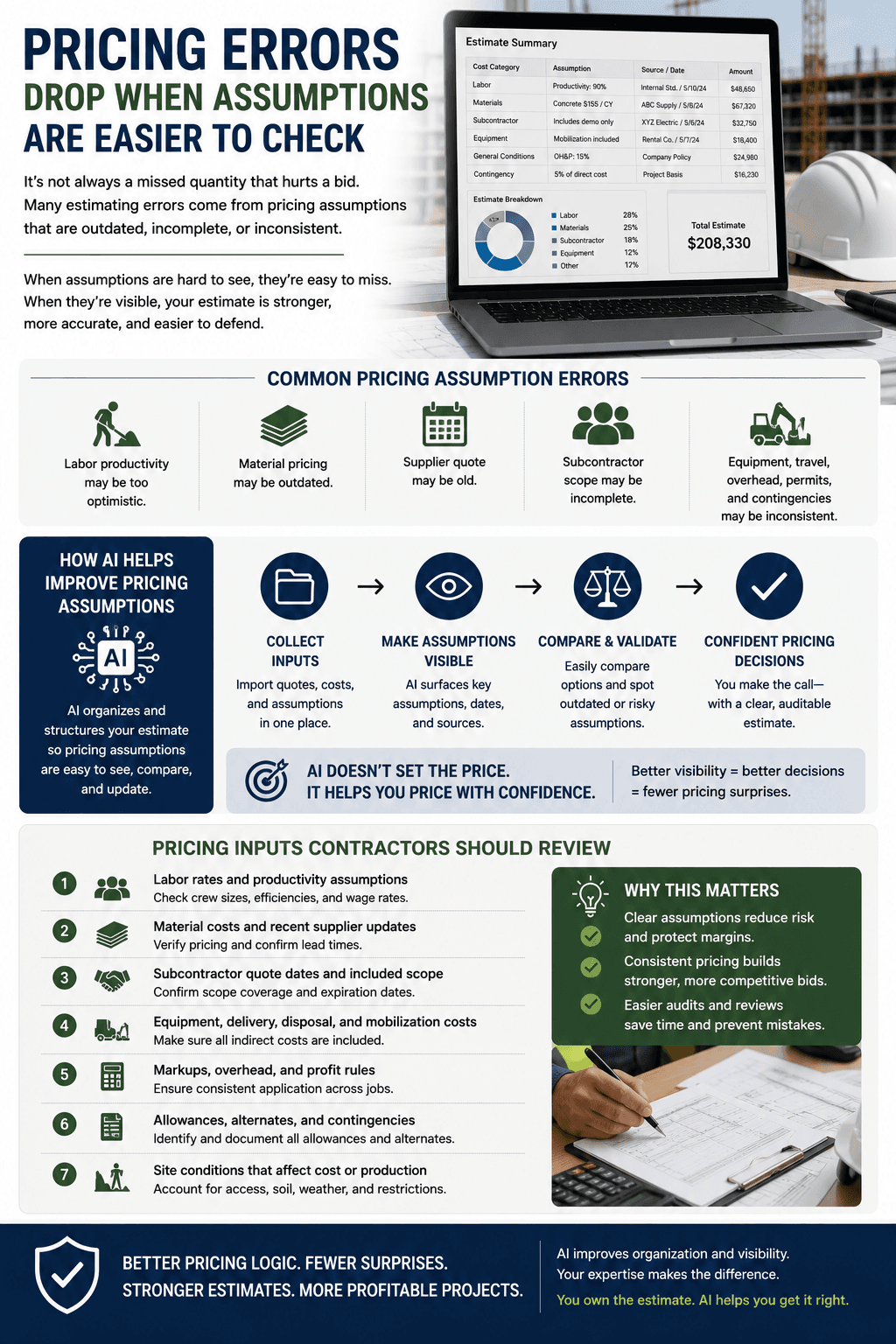
Contractors should not choose a tool just because it sounds advanced. The real test is whether it helps the team estimate better in daily use. A good platform should support real-world PDFs, messy document sets, review habits, revisions, scope notes, task visibility, and customer-ready proposals. It should make the estimator faster without taking control away from the people responsible for the bid.
A polished interface is helpful, but it is not enough. Contractors need to know whether the software can accommodate how their team actually works. Can it support the project types they estimate most often? Can it help organize documents? Can quantities be reviewed and adjusted? Can the team track changes? Can proposal preparation move faster without creating a formatting mess?
Contractors should ask:
- Can it handle real-world PDFs, specs, addenda, and messy document sets?
- Can estimators review and adjust quantities before making pricing decisions?
- Can it help identify scope gaps, omissions, and contradictions?
- Can it keep estimated details organized through revisions?
- Can it support proposal creation without extra formatting work?
- Can the team maintain control over final pricing, assumptions, and scope?
The best AI construction estimating software for contractors in 2026 can help contractors think through comparison points with workflow quality in mind. The best software should not just promise faster estimating. It should help contractors produce estimates that are easier to review, explain, and trust.
How To Use AI Takeoff Without Losing Estimator Control
The strongest use of AI keeps the estimator in charge. That should be the standard. Contractors should use AI to reduce repetitive work, improve document organization, support quantity extraction, and surface potential scope issues. Then experienced people should validate the output before anything turns into a final proposal.
A good review process should be part of the workflow every time. Estimators should check quantities, review scope, confirm pricing, write clear exclusions, validate supplier or subcontractor input, and approve the final version. AI can speed up the work, but final responsibility remains with the contractor.
This is not a weakness of the technology. It is how professional estimating should work. Good tools give estimators better information and more time to make stronger decisions. They do not remove the need for judgment, accountability, or experience.
Build Faster, More Defensible Takeoff Workflows With QuoteGoat
Contractors do not need more estimating chaos, more scattered files, or more late-night takeoff pressure. They need a cleaner system for plan review, automated quantity takeoffs, document understanding, scope checks, revisions, task visibility, and customer-ready estimates.
If your team is still rebuilding takeoffs by hand, chasing scope notes, or trying to catch bid risks at the last minute, QuoteGoat can help. Explore QuoteGoat’s estimating platform to see how AI-supported takeoff and scope review can help contractors move faster without giving up control of the estimate.